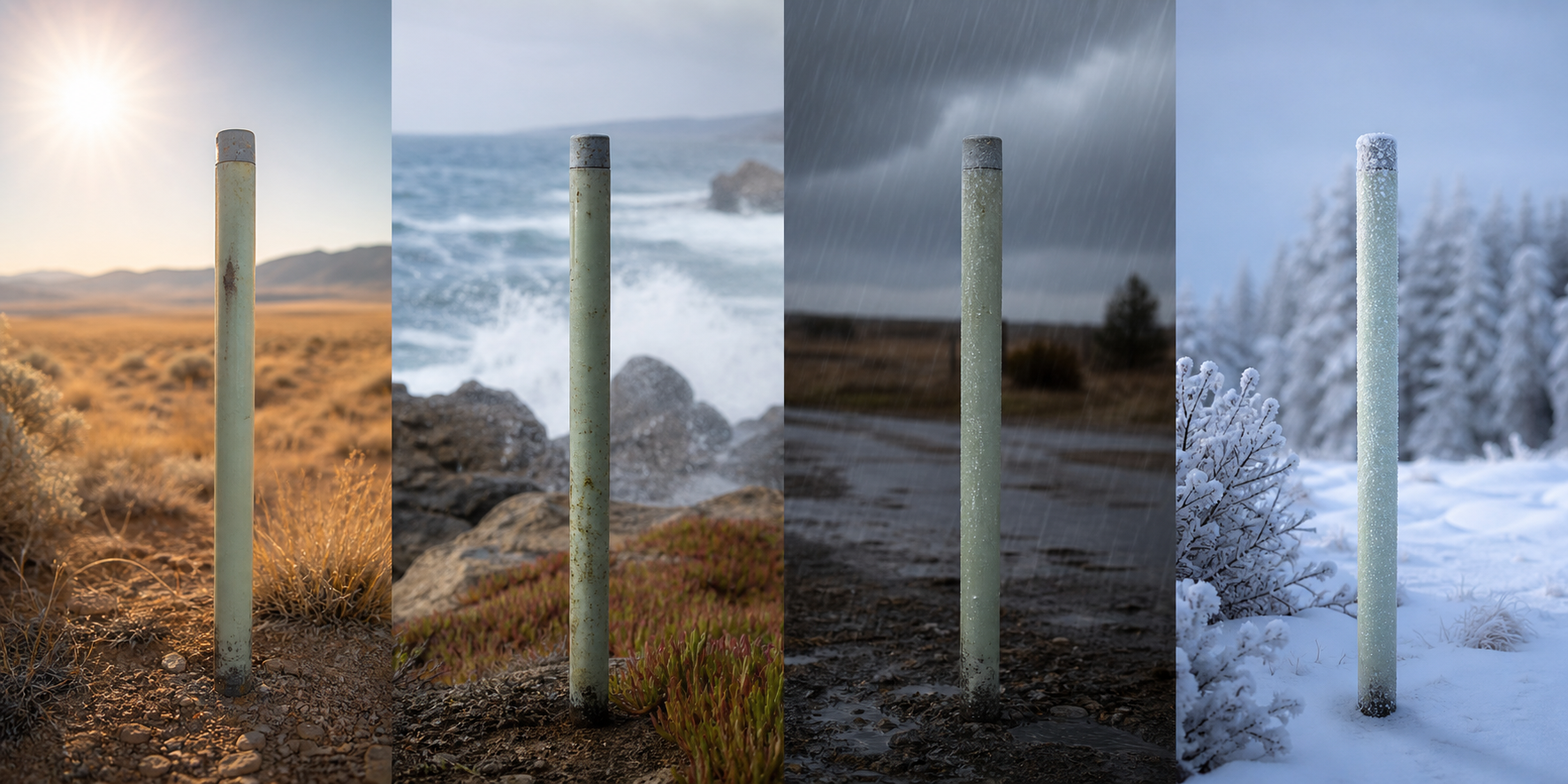
Fiberglass rods should hold their strength for decades after installation. Yet outdoor environments attack these composites through three interconnected degradation mechanisms that many purchasing managers and engineers don't fully account for when selecting materials.
UV radiation, moisture ingress, and chemical exposure each target different parts of the composite structure. When two or three of these forces overlap, the rate of property loss accelerates. Understanding how each mechanism works helps you specify fiberglass rods that hold up in the field rather than failing ahead of schedule.

This article breaks down how outdoor exposure degrades pultruded fiberglass rods and explains how resin selection, surface protection, and fiber architecture affect long-term durability.
Key Takeaways: How Outdoor Exposure Breaks Down Fiberglass Rods
- UV radiation breaks polymer chains in the resin matrix, causing surface chalking and eventual fiber exposure that accelerates further damage.
- Moisture ingress weakens the fiber-matrix interface through hydrolysis, reducing tensile strength by up to 24% in polyester-based profiles.
- Chemical attack from salt spray, acidic rain, or industrial vapors penetrates the resin barrier and directly targets glass fiber reinforcements.
- Tencom engineers custom pultruded fiberglass rods with tailored resin systems and UV-stabilized surface veils matched to your specific outdoor conditions.
- Vinyl ester and epoxy resin systems absorb less moisture and resist UV breakdown longer than standard polyester formulations in outdoor applications.
How Does UV Radiation Degrade Fiberglass Rods?
Ultraviolet radiation from sunlight penetrates the outer resin layer and breaks polymer chains through a process called photodegradation. UV energy generates free radicals that attack neighboring molecular bonds in a cascade of reactions.
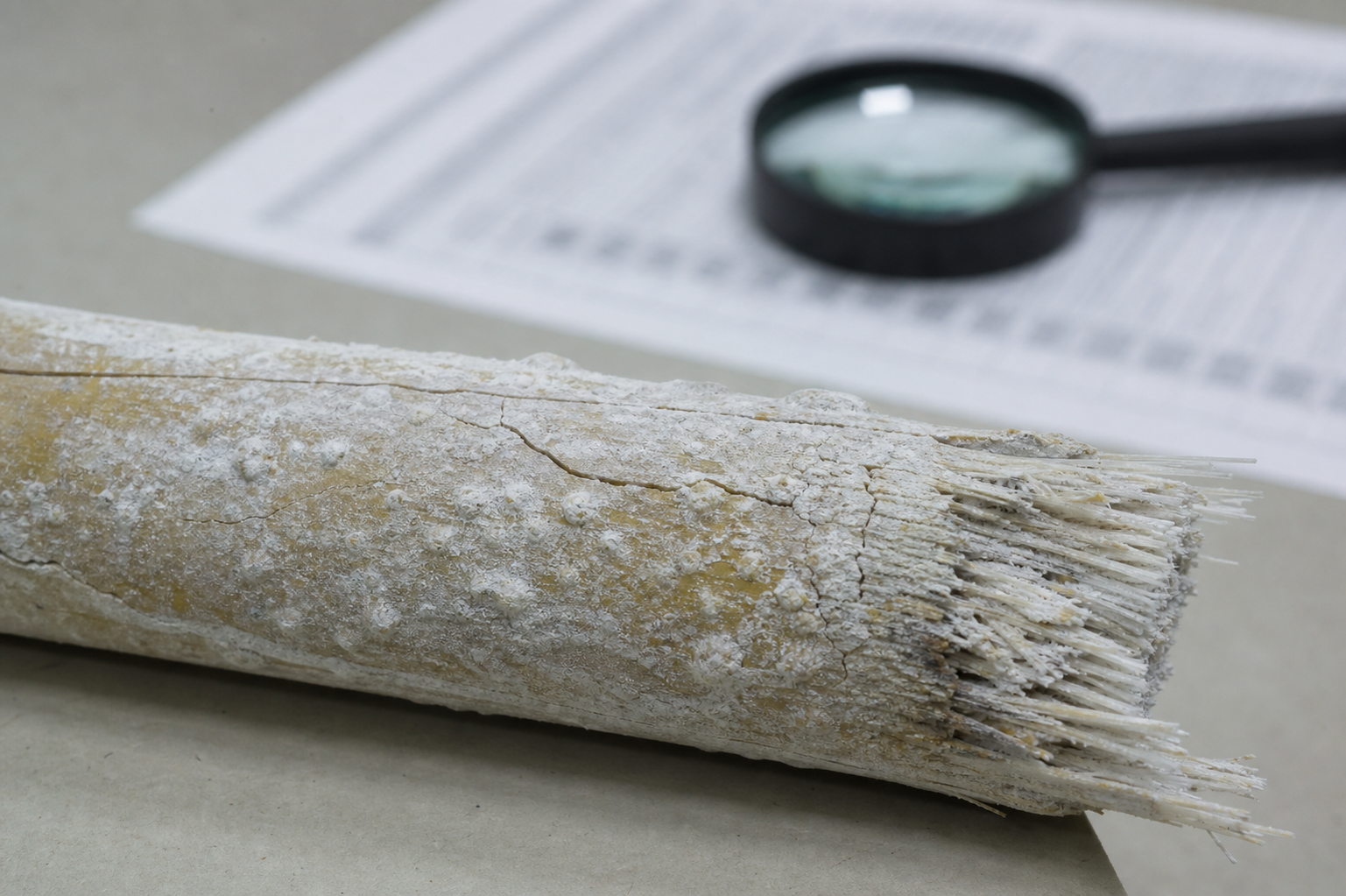
Visible signs appear first as yellowing, surface chalking, and loss of gloss. These aren't cosmetic issues alone. Once the outer resin erodes, glass fibers become directly exposed to the environment in a condition known as "fiber bloom."
Fiber bloom marks a critical turning point. Exposed fibers absorb water and become vulnerable to chemical attack. The protective barrier is gone, and property loss accelerates from that point forward.
Geographic location, rod orientation, and shading all affect how quickly UV damage progresses. Desert installations with intense, direct sunlight break down faster than shaded, northern-climate applications.
What Role Does Moisture Play in Fiberglass Rod Breakdown?
Water doesn't just sit on the surface of a fiberglass rod. Over time, it penetrates into the composite through microscopic pathways in the resin matrix. Cut ends, drilled holes, surface scratches, and manufacturing voids all create entry points.
The real damage occurs at the fiber-matrix interface. Water molecules insert themselves between glass fibers and the surrounding polymer, breaking bonds through hydrolysis. A study published in Frontiers in Materials found that moisture absorption reduced tensile strength by up to 24% in polyester-based GFRP profiles over 12 months of water immersion.
Temperature accelerates this process. Warm, humid environments drive water deeper into the composite structure faster than cold, dry conditions. Coastal and tropical installations face higher risk than arid-climate applications.
How Does Chemical Exposure Attack Outdoor Fiberglass Rods?
Salt spray, industrial vapors, acidic rain, and airborne pollutants create aggressive conditions that attack both the resin matrix and the glass fiber reinforcement. The mechanism depends on the specific chemical agent involved.
Alkaline and acidic environments cause the most severe damage. Acids attack the glass fibers directly, while alkaline solutions degrade the resin matrix and the silane coupling agents that bond fibers to the polymer. Industrial corridors, wastewater facilities, and coastal zones create overlapping chemical exposures.
When chemical attack combines with sustained mechanical loads, it results in stress-related cracking. This failure mode develops gradually as aggressive agents weaken glass fibers at points of concentrated stress, eventually causing fracture at loads well below the rod's original design capacity. Tencom's guide to FRP rod failure mechanisms explains how these forces interact.
Why Does Resin Selection Determine Outdoor Durability?
The resin matrix is the first line of defense against outdoor degradation. Different resin chemistries respond differently to UV exposure, moisture, and chemical attack.
Standard polyester resins are the most vulnerable to outdoor breakdown. They absorb more moisture, degrade faster under UV, and offer limited chemical resistance. Vinyl ester resins absorb significantly less water and resist UV degradation longer due to their molecular structure. Epoxy systems typically deliver the highest baseline resistance to all three mechanisms.
Tencom works with polyester, vinyl ester, epoxy, and polyurethane resin systems. Our engineers work backward from your requirements (temperature range, UV intensity, moisture conditions, chemical exposure) to recommend the right resin matrix and reinforcement package for your specific outdoor application.
How Do Surface Veils and UV Stabilizers Protect Fiberglass Rods?
Surface veils create a resin-rich outer layer that acts as a sacrificial barrier. This protective zone absorbs initial UV damage and slows moisture penetration, buying years (sometimes decades) of additional service life by keeping water and chemicals away from the structural fiber core.
UV-stabilizing additives, such as hindered amine light stabilizers (HALS), work differently. They neutralize the free radicals generated by photodegradation before those radicals can attack neighboring polymer chains. Because the stabilizers distribute throughout the resin, fresh protection becomes available even as the outermost surface erodes.
Color pigmentation adds another layer of defense. Pigment particles physically block and scatter UV radiation, reducing the energy that reaches the polymer bonds. Tencom integrates UV stabilizers and color pigmentation during the pultrusion process, building protection into every fiberglass rod from the start rather than relying on surface coatings that wear away over time.
When Do Custom FRP Components Outperform Standard Options Outdoors?
Generic catalog rods get close to what outdoor applications require. But "close enough" creates the same trade-offs project after project: extra bracing to compensate for property loss, more frequent replacements, or unexpected failures in harsh conditions.
Custom pultruded FRP components close that gap. When your installation faces combined UV, moisture, and chemical exposure, a profile engineered for those exact conditions reduces risk and total cost of ownership over the rod's full service life.
At Tencom, custom doesn't mean running whatever die you send. It means starting with your requirements and working backward. Our engineers sit down with your team (or your drawings) and look at the whole picture: mechanical loads, environmental exposure, dimensional requirements, and expected service life. Then we recommend the right resin matrix, reinforcement package, and profile geometry to hit your targets.
Because we've been focused on pultrusion for nearly 30 years, we can often suggest small changes that deliver outsized performance gains, such as adding a surface veil for better UV resistance or adjusting the fiber architecture for improved flexural strength in your specific outdoor application.
What Factors Accelerate Fiberglass Rod Degradation Outdoors?
Not all outdoor environments break down fiberglass rods at the same rate. Several factors determine how quickly your profiles lose their performance characteristics:
- UV intensity and exposure duration (determined by latitude, altitude, orientation, and shading)
- Temperature extremes and thermal cycling (daily and seasonal temperature swings)
- Humidity levels and direct water contact (rain, condensation, immersion)
- Chemical exposure from air pollution, salt spray, or industrial processes
- Mechanical stress combined with environmental factors (stress-related degradation)
Coastal installations face the combined assault of UV, salt spray, and humidity. Desert applications deal with intense UV and extreme temperature fluctuations. Understanding your specific environment helps you specify the right material combination for the job.
In Conclusion: Choosing Fiberglass Rods That Perform Outdoors
Outdoor fiberglass rod degradation comes down to three connected mechanisms: UV exposure attacks the surface resin, moisture ingress weakens the fiber-matrix interface, and chemical exposure compromises both the matrix and the reinforcement. The rate of breakdown depends on environmental severity, resin selection, surface protection, and manufacturing quality.
If you've been specifying fiberglass rods that don't hold up outdoors, it's worth looking at what a custom approach can deliver. Ready to specify rods that perform reliably in your outdoor environment? Request a quote or start a conversation with our engineering team. We'll help you figure out whether a custom pultruded solution makes sense for your application.
FAQs About How Outdoor Exposure Breaks Down Fiberglass Rods
Can fiberglass rods last outdoors without degrading?
Yes, when specified with the right resin system, surface protection, and UV stabilizers matched to the installation environment. Tencom engineers custom fiberglass rods with these protective features built in during pultrusion, extending outdoor service life far beyond what unprotected standard profiles deliver.
Which resin system resists outdoor degradation the longest?
Epoxy resins generally offer the highest baseline resistance to UV, moisture, and chemical attack. Vinyl ester is a strong performer for most outdoor applications at a more accessible price point. Tencom helps you match the resin system to your specific exposure conditions so you don't over-specify or under-protect.
How does moisture damage differ from UV damage in fiberglass?
UV damage primarily affects the surface resin through photodegradation, causing chalking and fiber exposure. Moisture damage occurs deeper in the composite, weakening the bond between glass fibers and resin through hydrolysis. Both reduce mechanical properties, but they target different parts of the structure.
Does color affect how fast fiberglass rods degrade outdoors?
Pigmented rods generally last longer outdoors because pigment particles block UV radiation from reaching the polymer bonds. Darker colors absorb more heat, which can accelerate moisture-related degradation in some climates. Tencom offers color pigmentation integrated during pultrusion for protection that runs through the entire profile cross-section.
What should you specify to prevent outdoor fiberglass rod failure?
Start with resin selection matched to your UV, moisture, and chemical exposure levels. Add a surface veil for moisture and UV protection. Confirm that the resin formulation includes UV stabilizers. Tencom's engineering team helps you build these specifications from your actual field conditions rather than relying on generic catalog descriptions.