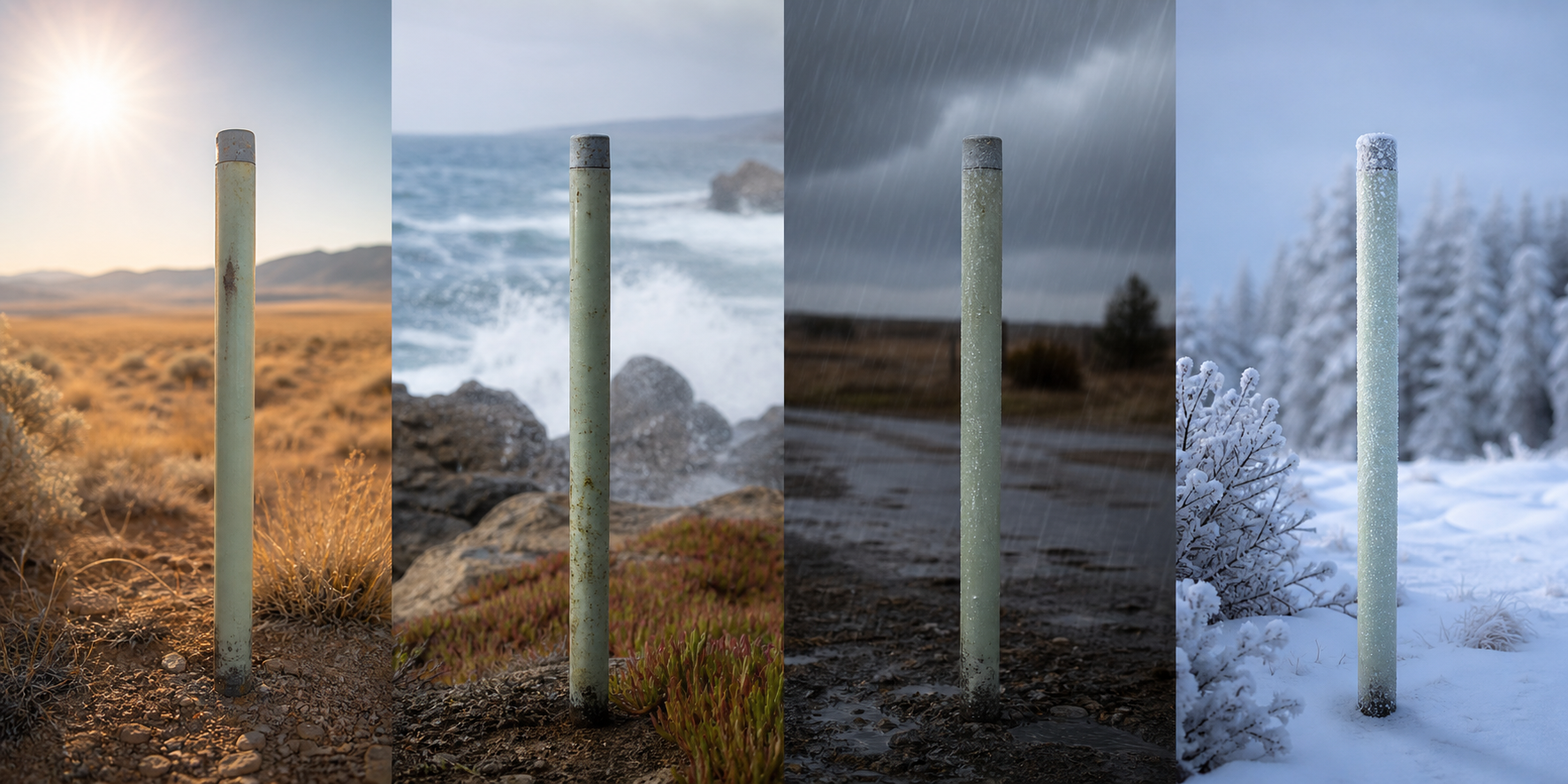


Pultruded fiberglass rods can last for decades—when you protect them from the right threats. But outdoor environments throw everything they have at composite materials: sun, rain, salt, heat, and mechanical wear. Tencom manufactures custom fiberglass rods with UV stabilization and corrosion-resistant resin systems built directly into the production process.
This guide walks you through nine outdoor exposure factors that can shorten the service life of fiberglass rods, along with practical steps to prevent each. You'll learn how to select the right materials and protective measures to keep your rods performing in demanding environments.
Quick guide: 9 Outdoor Factors Affecting Fiberglass Rod Durability
- UV Radiation: The most common outdoor degradation trigger for exposed composites
- Moisture Infiltration: Water that reaches the fiber-resin interface weakens structural bonds
- Thermal Cycling: Repeated temperature swings cause micro-cracking over time
- Salt Spray Exposure: Coastal and marine environments accelerate surface degradation
- Alkaline Soil Contact: High-pH environments attack glass fibers through the resin barrier
- Mechanical Abrasion: Physical wear removes protective surface layers
- Improper Resin Selection: Mismatched resin chemistry fails under specific environmental loads
- Handling and Installation Damage: Scratches and unsealed cut ends create entry points for degradation
- Chemical Exposure: Solvents and industrial chemicals break down the polymer matrix
How We Identified the Factors That Degrade Fiberglass Rods
When you're sourcing pultruded fiberglass rods for outdoor applications, understanding failure mechanisms helps you specify the right materials from the start. We reviewed published research on composite durability, analyzed field performance data, and consulted with engineers who design for demanding environments.
- Real-world exposure data: A ten-year outdoor exposure study published in Polymers tracked GFRP performance to identify which factors cause measurable strength loss
- Resin system comparison: Research comparing vinyl ester and polyester matrices shows how resin selection affects long-term moisture resistance
- Failure analysis patterns: Common failure modes documented by testing laboratories point to specific environmental triggers
- Application-specific performance: Field reports from utilities, marine installations, and agricultural operations reveal which factors matter most in each environment
- Prevention effectiveness: Documented cases where protective measures extended service life by years or decades
The 9 Outdoor Factors that Degrade Fiberglass Rods
1. UV Radiation: The primary outdoor degradation factor for fiberglass rods
Ultraviolet radiation from sunlight breaks down the polymer resin matrix that holds glass fibers together. Over months and years of direct sun exposure, unprotected fiberglass rods develop a chalky surface texture called "fiber bloom." This happens when UV energy degrades the resin layer, exposing the underlying glass reinforcement.
Once fibers become exposed, water and contaminants reach the structural core more easily. The degradation accelerates from that point forward. Tencom builds UV stabilizers directly into fiberglass rods during manufacturing, protecting the resin matrix from the inside out rather than relying solely on surface coatings that can wear off.
Color pigmentation also helps. Darker colors and opaque formulations block UV penetration more effectively than clear or translucent rods. For outdoor applications with direct sun exposure, specifying UV-stabilized rods with integrated pigmentation gives you two layers of protection.
Tencom fiberglass rod benefits for UV protection
- Integrated UV stabilizers: Added during pultrusion, these additives protect the entire rod cross-section rather than just the surface, so protection remains effective even if the surface gets scratched
- Color pigmentation options: Tencom can add pigments during production to block UV penetration—you choose colors that match your application requirements while gaining additional protection
- Vinyl ester resin systems: These outperform standard polyester in outdoor applications because they resist moisture and chemical attack better over time
- Protective surface veils: An optional outer layer acts as a sacrificial barrier, taking the UV damage while the structural core stays protected
- Custom resin formulations: Tencom's engineering team can develop application-specific resin blends that match your exact environmental exposure conditions
- Design and engineering support: Get guidance on material selection before you order, so your rods arrive ready for your specific outdoor environment
Tencom pros and cons
Pros:
- Lower minimum order quantities let you test materials in your application before committing to large production runs
- Custom research and testing capabilities mean you can validate performance for your specific environmental conditions
- Tailored service approach—Tencom's engineering team works directly with you on material selection and design optimization
Cons:
- Custom tooling may be required for non-standard profile shapes, though tooling is reusable for future orders
- Lead times for custom formulations depend on testing requirements, so plan ahead for complex projects
- Standard profiles may need modification for highly specialized applications, which adds design time
2. Moisture Infiltration: How water damages fiberglass composites
Water that penetrates the resin matrix can weaken the bond between glass fibers and the polymer that holds them together. This process—sometimes called "fiber-matrix debonding"—reduces the rod's load-carrying capacity over time.
Moisture enters through exposed cut ends, surface scratches, or microscopic cracks in the resin. High-humidity environments accelerate the process, even without direct water contact. Research published in Frontiers in Materials shows that vinyl ester resin systems resist moisture penetration significantly better than standard polyester.
Moisture infiltration features to consider
- Sealed cut ends: Applying end caps or sealant prevents moisture from wicking along the fiber-matrix interface
- Vinyl ester resin: Offers superior moisture barrier properties compared to polyester matrices
- Surface veil protection: Creates an additional barrier layer against environmental moisture
Moisture protection pros and cons
Pros:
- Proper resin selection can dramatically extend service life in humid or wet environments
- Sealing cut ends is a straightforward field practice that adds years of durability
- Surface veils can be specified during manufacturing without significant cost increases
Cons:
- Moisture damage often goes undetected until structural performance declines
- High-humidity environments require more frequent inspection schedules
- Retrofitting moisture protection to existing installations requires additional field work
3. Thermal Cycling: Temperature swings create micro-damage
Glass fibers and polymer resins expand and contract at different rates when temperatures change. Repeated cycling between hot and cold creates internal stresses at the fiber-matrix interface. Over hundreds or thousands of cycles, micro-cracks can develop in the resin.
The effect becomes more pronounced with larger temperature swings. Desert environments with hot days and cold nights, or seasonal climates with summer-to-winter extremes, put more thermal stress on fiberglass components. Tencom designs custom profiles that account for expected temperature ranges in your application.
Thermal cycling features
- Matched thermal expansion: Proper resin-fiber combinations minimize differential expansion
- Temperature-rated resins: High-temperature resin options maintain stability across wider ranges
- Application engineering: Design support accounts for thermal loads in your specific environment
Thermal cycling pros and cons
Pros:
- Fiberglass has better thermal stability than many traditional materials like wood or certain plastics
- Proper resin selection can extend operating temperature ranges significantly
- Dimensional stability under temperature changes is one of fiberglass's inherent advantages
Cons:
- Extreme temperature swings require careful material specification during the design phase
- Thermal micro-cracking develops gradually and may not be visible without testing
- Applications with rapid temperature changes need specialized resin formulations
4. Salt Spray Exposure: Coastal environment challenges
Salt air in coastal and marine environments can accelerate surface degradation of fiberglass rods. While fiberglass resists salt far better than steel or aluminum, prolonged exposure without proper protection can still cause problems.
Salt deposits on the surface can hold moisture against the rod, creating conditions for localized degradation. Additionally, salt can penetrate micro-cracks and accelerate any existing damage. For marine and coastal applications, specifying rods with enhanced surface protection makes a measurable difference in service life.
Salt spray features
- Vinyl ester resin: Offers enhanced resistance to salt and brine solutions
- Protective gel coats: Optional surface treatments add an extra barrier against salt penetration
- Non-porous surface finish: Reduces salt deposit accumulation and simplifies cleaning
Salt spray pros and cons
Pros:
- Fiberglass inherently resists salt-based degradation far better than metallic alternatives
- Proper resin selection eliminates most salt-related durability concerns
- Maintenance requirements remain low even in demanding coastal installations
Cons:
- Standard polyester resins may not perform adequately in direct marine exposure
- Some applications require periodic surface cleaning to remove accumulated salt deposits
- Full marine immersion applications need specific resin and surface treatments
5. Alkaline Soil Contact: Underground and buried applications
Fiberglass rods buried in alkaline soils face a specific chemical challenge. High-pH environments can attack glass fibers over time if the resin barrier becomes compromised. This "alkaline attack" is well documented in civil engineering research and affects long-term durability under certain soil conditions.
The rate of degradation depends on soil pH, moisture content, and the resin system used. Vinyl ester resins resist alkaline attack significantly better than polyester alternatives. For buried applications, soil testing and proper material specification prevent premature failure.
Alkaline soil features
- Alkaline-resistant resin: Vinyl ester and specialty formulations resist high-pH environments
- Enhanced fiber protection: Proper resin coverage prevents direct soil-to-fiber contact
- Application engineering: Material selection based on actual soil chemistry data
Alkaline soil pros and cons
Pros:
- Proper resin selection enables reliable performance even in challenging soil conditions
- Unlike steel, fiberglass does not suffer galvanic effects when buried near other materials
- Lightweight properties simplify installation in trenching and underground applications
Cons:
- Soil testing may be required to determine proper material specification
- Standard polyester resins have limited suitability for high-alkalinity burial
- Very aggressive soil conditions may require specialty resin formulations
6. Mechanical Abrasion: Physical wear removes protection
Fiberglass rods in outdoor applications often experience mechanical wear from vibration, friction against mounting hardware, wind-driven particles, or repeated handling. This abrasion can remove protective surface layers and create entry points for UV, moisture, and chemical degradation.
The exposed areas then degrade faster than protected surfaces. High-abrasion applications benefit from surface veils, protective sleeves, or hardened gel coats that take the wear while the structural core remains protected. Tencom offers custom fiberglass rods with surface treatments matched to your abrasion environment.
Mechanical abrasion features
- Surface veils: Resin-rich outer layers resist abrasion while protecting the structural core
- Gel coat options: Hard surface treatments add wear resistance for high-friction applications
- Custom profiles: Shape optimization can reduce contact stress at mounting points
Mechanical abrasion pros and cons
Pros:
- Surface protection can be specified during manufacturing at relatively low cost
- Fiberglass maintains structural integrity even with moderate surface wear
- Regular inspection allows you to address wear before it affects performance
Cons:
- High-vibration applications may require periodic inspection schedules
- Surface damage from impact is more difficult to repair than abrasion wear
- Very high-abrasion applications may need external protective sleeves
7. Improper Resin Selection: Mismatched chemistry fails faster
Choosing the wrong resin system for your environment is one of the most common causes of premature fiberglass failure. Standard polyester resins work well for many applications, but they fall short in harsh chemical environments, high temperatures, or prolonged water exposure.
Vinyl ester resins cost more but deliver better performance in demanding conditions. Specialty resins—including fire-retardant, high-temperature, and chemically-resistant formulations—address specific application requirements. Tencom's engineering team helps you match resin chemistry to your actual operating conditions.
Resin selection features
- Polyester options: Cost-effective for moderate environments and general-purpose applications
- Vinyl ester options: Superior performance for chemical, moisture, and temperature resistance
- Specialty formulations: Fire-retardant, high-temperature, and application-specific resin systems
Resin selection pros and cons
Pros:
- Material selection support helps you specify the right resin without overspending
- Custom resin formulations can be developed for unusual environmental combinations
- Proper resin selection from the start prevents costly field failures and replacements
Cons:
- Higher-performance resins add to material costs
- Complex environments may require material testing before final specification
- Switching resin systems on existing tooling may require validation runs
8. Handling and Installation Damage: Prevention at the job site
Many fiberglass failures trace back to damage during shipping, handling, or installation. Scratches remove protective surface layers. Impacts can create internal cracks that are not visible from the outside. Unsealed cut ends allow moisture to wick along the fiber-matrix interface for the rod's entire length.
Proper handling practices protect your investment. Store rods away from direct sunlight before installation. Use appropriate lifting equipment to prevent bending damage. Seal all cut ends immediately after cutting. These simple practices extend service life.
Handling and installation features
- Protective packaging: Proper shipping materials prevent transit damage
- Pre-cut lengths: Factory cutting eliminates field cut ends that need sealing
- End-sealing options: Pre-sealed ends or recommended sealant specifications
Handling and installation pros and cons
Pros:
- Damage prevention costs far less than premature replacement
- Factory-cut and sealed rods arrive ready for immediate installation
- Simple handling guidelines extend service life significantly
Cons:
- Field damage may not be immediately visible after installation
- Job site conditions sometimes make ideal handling practices difficult
- Training crews on proper handling requires upfront time investment
9. Chemical Exposure: Industrial environments and solvents
Beyond the natural environment, many outdoor fiberglass installations face exposure to industrial chemicals, solvents, fuels, or cleaning agents. These substances can attack the resin matrix, softening it or causing it to swell and lose adhesion to the reinforcing fibers.
Different resin systems resist different chemical families. Polyester resins handle many common chemicals, but vinyl ester offers broader resistance. Specialty resins address specific chemical exposures. Tencom manufactures custom fiberglass rods with resin systems matched to your chemical environment.
Chemical exposure features
- Chemical resistance charts: Material specifications include resistance ratings for common chemicals
- Custom formulations: Resin systems optimized for specific chemical exposure profiles
- Testing capabilities: Validation testing for unusual chemical combinations
Chemical exposure pros and cons
Pros:
- Fiberglass resists many chemicals that destroy metallic alternatives
- Proper resin selection eliminates most chemical compatibility concerns
- Chemical resistance can be validated through testing before production
Cons:
- Some aggressive chemicals require specialty resin systems
- Unknown chemical exposures may require field testing or analysis
- Concentrated solvent exposure can affect even resistant resin systems
How Long Do Properly Protected Fiberglass Rods Last Outdoors?
Pultruded fiberglass rods with appropriate UV stabilization, resin selection, and surface protection can deliver 25 to 50 years of outdoor service life. A study published in Polymers documented that pultruded GFRP maintained significant structural properties after 10 years of direct outdoor exposure in Japan.
The key variables are material specification and environmental severity. Moderate climates with limited UV exposure and low chemical contact allow longer service. Harsh marine environments, extreme UV zones, or chemically aggressive conditions require premium materials but still deliver decades of reliable performance.
Tencom engineers help you match material specifications to your expected service conditions. This upfront design work maximizes your return on investment by avoiding both over-specification (paying for protection you don't need) and under-specification (facing premature replacement).
What Maintenance Extends Fiberglass Rod Service Life?
Fiberglass rods require minimal maintenance compared to wood, steel, or aluminum alternatives. Regular visual inspection catches surface damage before it becomes structural. Cleaning removes salt deposits, chemical residues, or organic matter that could hold moisture against the rod surface.
For critical applications, periodic testing can verify that rods continue to meet performance requirements. Non-destructive testing methods can identify internal damage that is not visible from the outside. Most outdoor fiberglass installations, however, operate for decades with only visual inspection and occasional cleaning.
Tencom designs custom fiberglass rods for low-maintenance performance. By building protection into the material rather than relying on external coatings, you get durable performance without ongoing treatment costs.
Why Tencom is the Best Choice for Outdoor Fiberglass Rods
Protecting pultruded fiberglass rods from outdoor degradation starts with material specification—and Tencom delivers the custom engineering support that gets specifications right the first time. Unlike high-volume pultruders focused on standard shapes, Tencom specializes in custom profiles with resin systems and protective features matched to your specific environment.
Tencom builds UV stabilizers, color pigmentation, and corrosion-resistant resins directly into fiberglass rods during the pultrusion process. This approach protects the entire rod cross-section, not just the surface. Even if the outer layer gets scratched during installation or service, the underlying material retains its protective chemistry.
Lower minimum order quantities let you test materials in your application before committing to large production runs. Custom research and testing capabilities validate performance for unusual environmental combinations. And direct access to Tencom's engineering team means you get material selection guidance from experts who understand composite durability. Request a quote to start designing fiberglass rods that perform in your outdoor environment.
FAQs about outdoor factors that degrade fiberglass rods
What causes fiberglass rods to degrade outdoors?
UV radiation from sunlight is the primary factor in the degradation of outdoor fiberglass rods. Ultraviolet radiation breaks down the polymer resin matrix, causing surface chalking and eventual fiber exposure.
Other factors include moisture infiltration, thermal cycling, salt spray, alkaline soils, mechanical abrasion, improper resin selection, handling damage, and chemical exposure. Tencom manufactures custom fiberglass rods with integrated UV stabilizers and corrosion-resistant resins to prevent these degradation mechanisms.
How can I prevent UV damage to fiberglass rods?
Specify fiberglass rods with UV stabilizers built into the resin system during pultrusion. This approach protects the entire rod rather than relying on surface coatings that can wear away.
Color pigmentation adds a second layer of protection by blocking UV penetration. Tencom integrates UV stabilizers and pigments into the manufacturing process, providing protection that lasts throughout the rod's full service life.
Which resin system works best for outdoor fiberglass applications?
Vinyl ester resin outperforms standard polyester in most demanding outdoor environments. It offers superior moisture resistance, better chemical durability, and improved performance under temperature cycling.
Tencom offers both polyester and vinyl ester options, plus specialty formulations for specific challenges. The engineering team helps you select the right resin system for your specific environmental conditions.
Do fiberglass rods need maintenance in outdoor installations?
Properly specified fiberglass rods require minimal maintenance. Periodic visual inspection catches surface damage early. Occasional cleaning removes deposits that could trap moisture or chemicals against the surface.
Unlike wood or steel, fiberglass does not need painting, sealing, or protective treatments during service. Tencom builds protection directly into the material, reducing your lifetime maintenance costs.
How long do fiberglass rods last in outdoor environments?
With appropriate UV stabilization and resin selection, pultruded fiberglass rods can deliver 25 to 50 years of outdoor service. Published research shows that GFRP maintains its structural properties after 10 years of direct outdoor exposure.
Tencom's engineering team helps you specify materials that match your expected service conditions, maximizing durability without over-specifying and unnecessarily increasing costs.