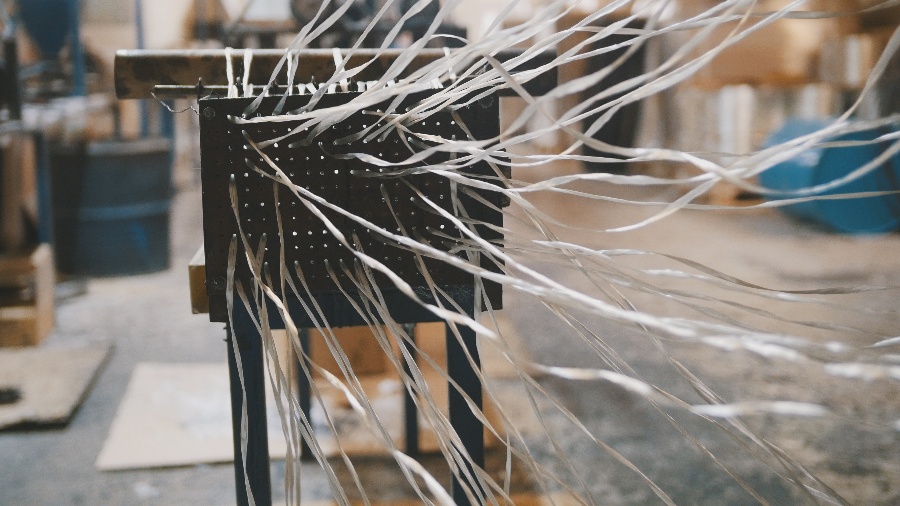
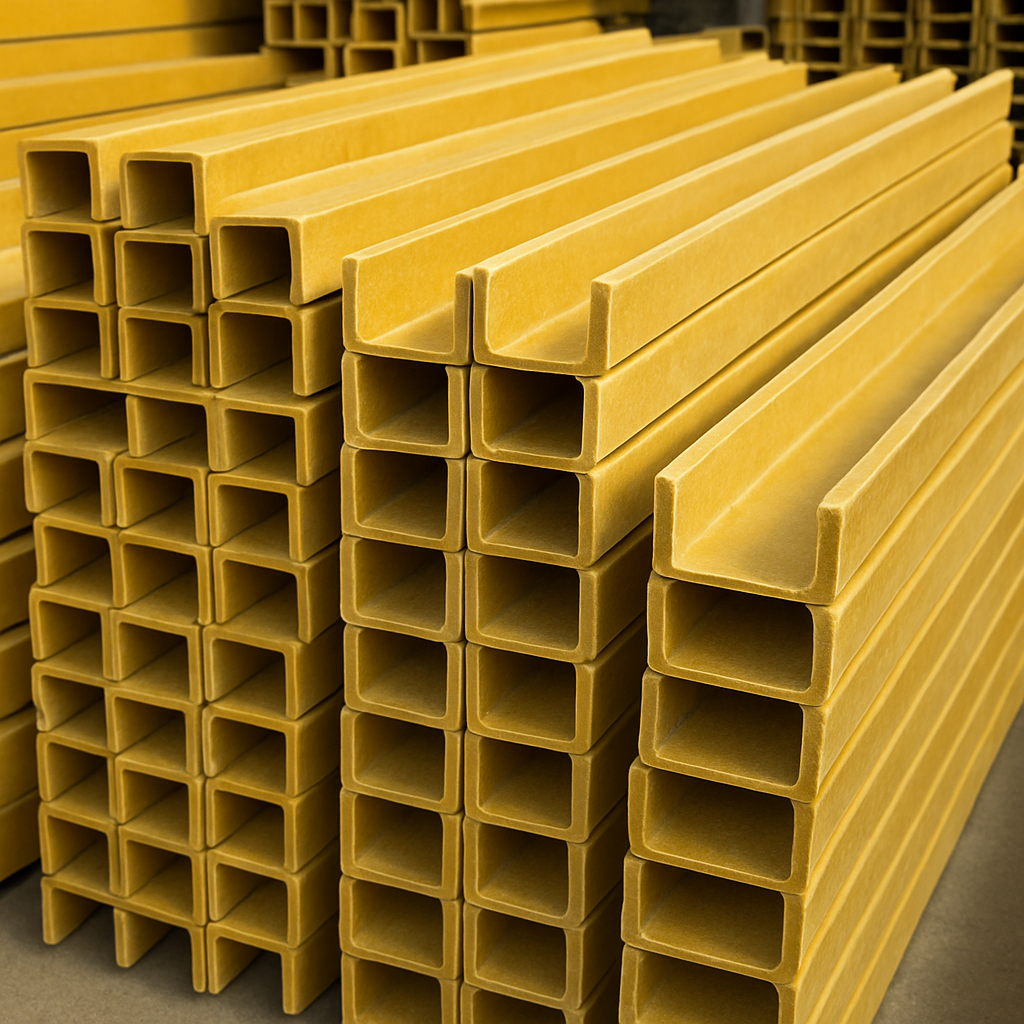
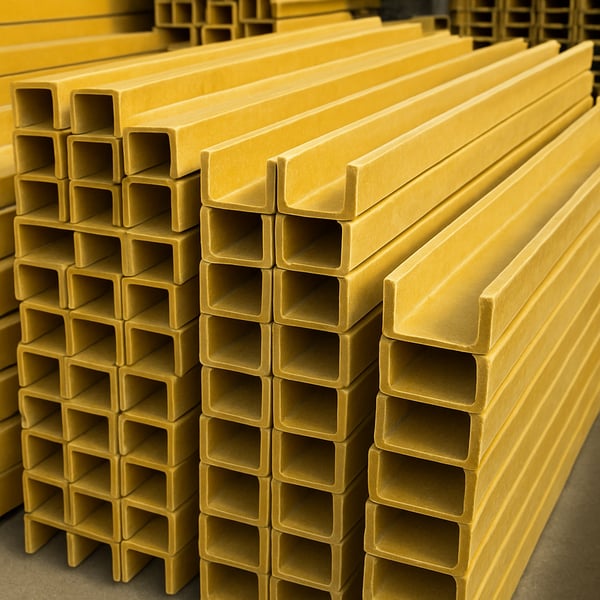
Pultruded fiberglass channels are produced by a pultrusion process in which reinforced fibers and liquid resin are combined to form a fiber-reinforced plastic (FRP). It's then shaped into channels of various sizes and shapes to meet specific requirements.
The continuous length of the reinforcing fibers gives these lightweight channels their exceptional tensile strength. They're available as structural pultrusions or pultruded electrical shapes.
When you work with our team of expert engineers on the production process, you can adjust the resin systems and glass content and change the composite matrices to produce pultruded fiberglass channels with different properties, such as high strength, high-temperature tolerance, flame-retardant, track-resistant, and corrosion-resistant.
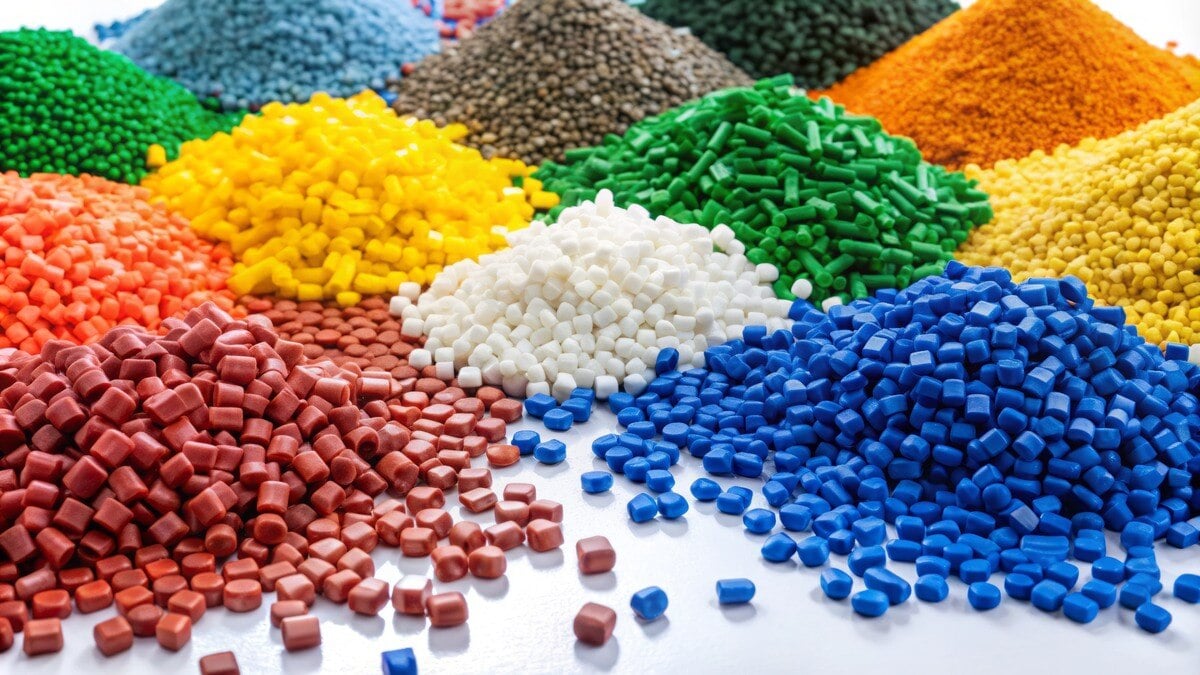
In addition, pigments can be added during pultrusion to produce channels in various colors, and a UV-resistant treatment can be applied to increase their durability, making them ideal for outdoor applications.

Advantages Of Pultruded Fiberglass Channels
Pultruded fiberglass channels won't mildew, scale, rot, or rust, and are superior to many traditional materials, such as wood, steel, and aluminum, thanks to their unique properties:
- Corrosion-resistant and chemical-resistant: FRP is resistant to a broad range of chemicals and isn't affected by oxidation and corrosion, eliminating the cost associated with painting or galvanization.
- Lightweight yet high-strength: pultruded fiberglass channels can be 30% lighter than aluminum and 70% lighter than steel without sacrificing strength. In particular, it offers exceptional dimensional stability, and its tensile strength is much higher than that of steel in a pound-to-pound comparison.
- Flexible and impact-resistant: FRP does not deform permanently under working load, which is distributed by the glass mat to prevent surface damage.
- Non-conductive: pultruded fiberglass channels are both electrically and thermally non-conductive, making them a safe option for many applications.
- Cost-efficient: pultruded fiberglass channels are economical to transport and easy to handle (e.g., cut and shaped using simple tools), reducing the overall cost of any project.
- Highly durable: since they don't deteriorate or rust, pultruded fiberglass channels have a long lifecycle with very low maintenance requirements and costs.
- EMI/RFI transparent: non-magnetic electromagnetic transparency makes pultruded fiberglass channels ideal for many specialized applications where metal parts can cause interference.
- Sustainability: the manufacturing, transport, and installation of pultruded FRP products are energy-efficient, require less heat, produce less wastage, and cause less pollution. In addition, FRP can have a lifecycle of 75-150 years and be recycled or reformed into other plastic-based products -- making it an eco-friendly choice for many industries (e.g., construction, manufacturing.)
Applications Of Pultruded Fiberglass Channels
Pultruded fiberglass channels are instrumental in applications in which metals can't provide an ideal solution, e.g., where corrosion is a concern or lightweight structural shapes are required for easy installation.
Thanks to their lightweight, easy installation, versatility, strength, durability, and long lifecycle, pultruded fiberglass channels are widely used in various industries, including:
- Construction and Infrastructure: FRP is often used in outdoor construction projects thanks to its durability. They can be cut and shaped using simple tools for easy installation, while their low maintenance requirements mean a low cost of ownership. In particular, pultruded fiberglass C-channels are commonly used as floor joints thanks to their high tensile strength and ease of installation. In addition, they are used in bridge components, corrosion-resistant guardrails, railway crossing arms, and highway sound barriers.
- Utility and Telecommunications: pultruded fiberglass channels' durability, non-conductivity, low maintenance requirements, and EMI/RFI transparency make them ideal for applications such as utility poles, cross arms, and line markers, electrical lines and trunking, wastewater and water treatment components, non-conductive ladder rails, and fiber optic cabling.
- Tool Manufacturing: FRP can be made into various shapes and sizes to create ergonomic shapes for handheld tools or devices. Its low cost, versatility, reliability, and non-conductivity make it a popular choice for manufacturers.
- Sporting, Recreational, and Outdoor Equipment: pultruded fiberglass channels are often used in outdoor equipment that needs to withstand moisture, sunlight, heat, and heavy wear. They can be used for anything from outdoor furniture to high-performance sporting equipment such as golf clubs, hockey sticks, sailing equipment, paddles, and ski poles.
Pultruded Fiberglass Channels: Turning Design Concept Into Reality
For over 28 years, Tencom's expert engineers have helped designers, builders, and manufacturers in various industries turn design ideas into reality. We can help you customize FRP components and integrate them into your manufacturing process so you can get the right product at the right time and at the right price.