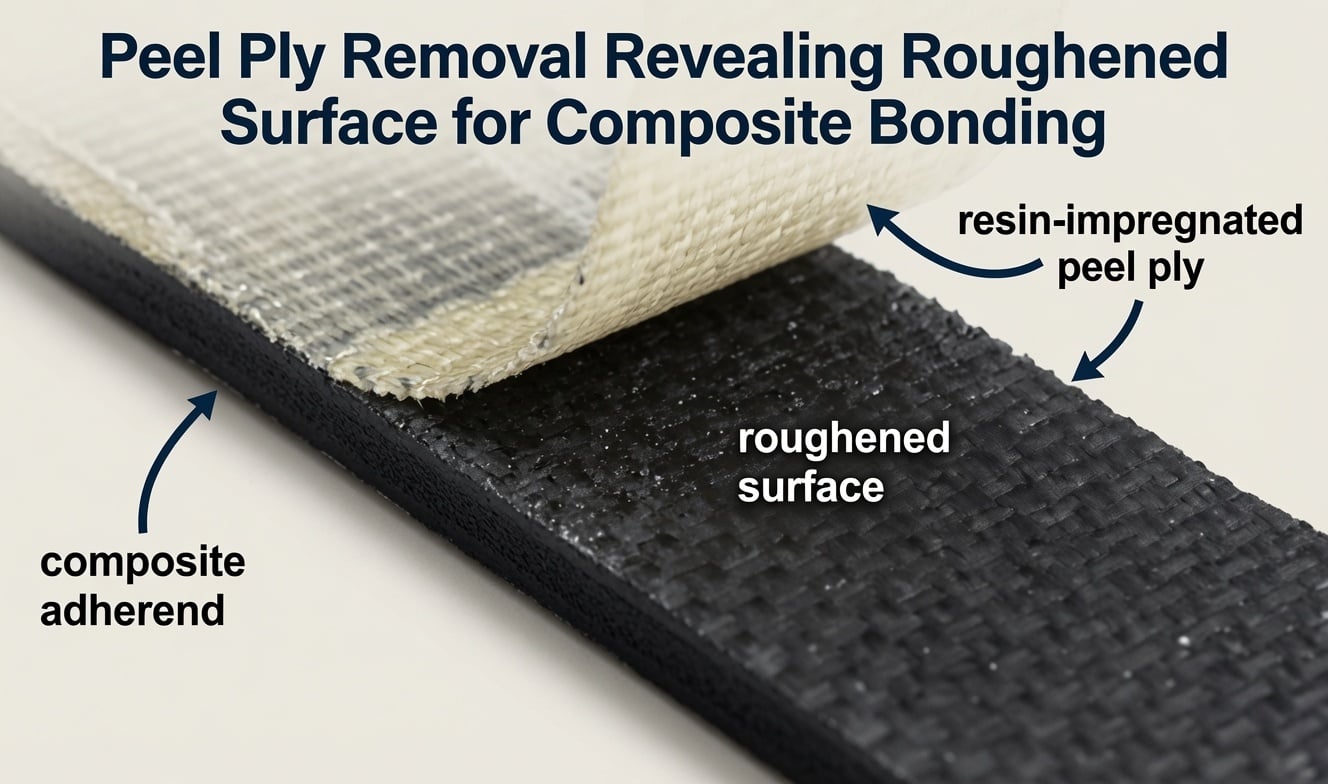
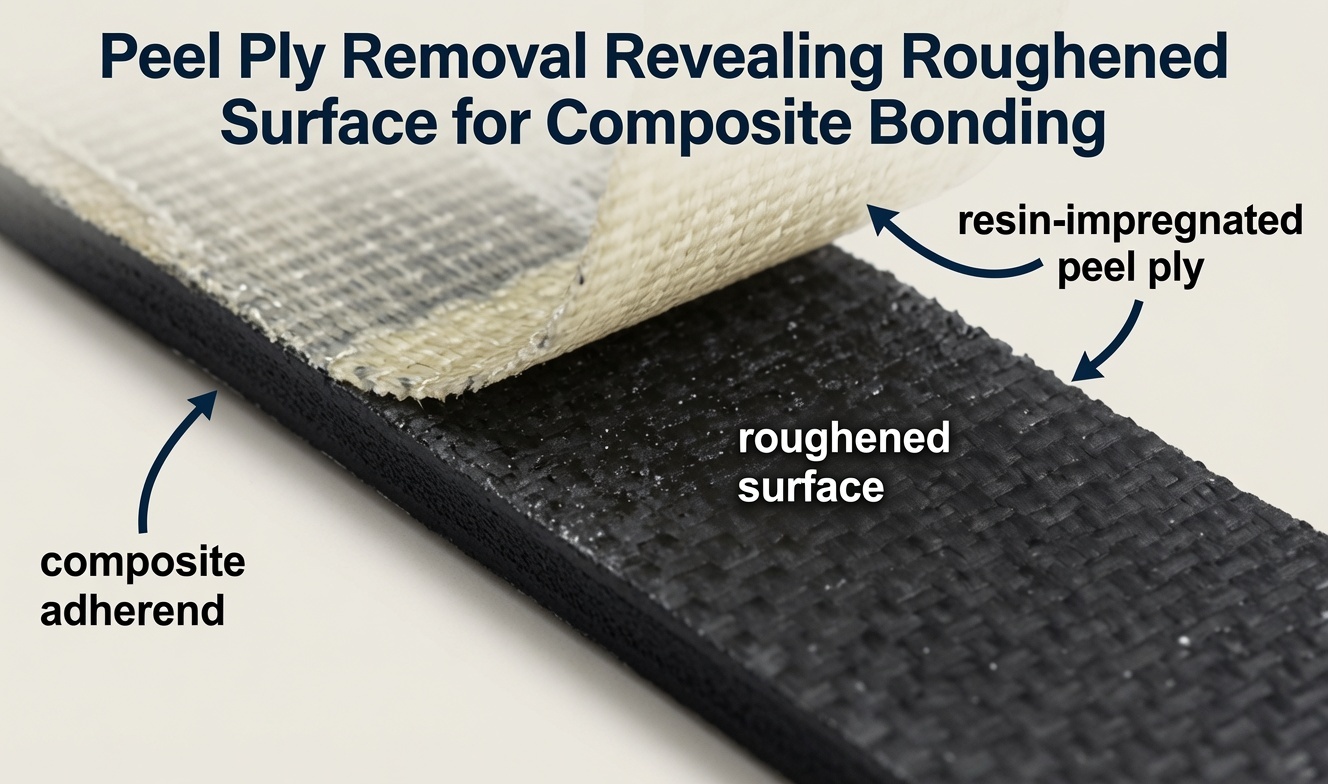
If you’ve ever laid up fiberglass or carbon fiber and then faced hours of sanding just to get a surface ready for bonding or paint, you know the pain. There’s a better way — one that leaves a clean, textured, bond-ready surface almost automatically. It’s called peel ply, and it’s one of the most practical tools in composite manufacturing.
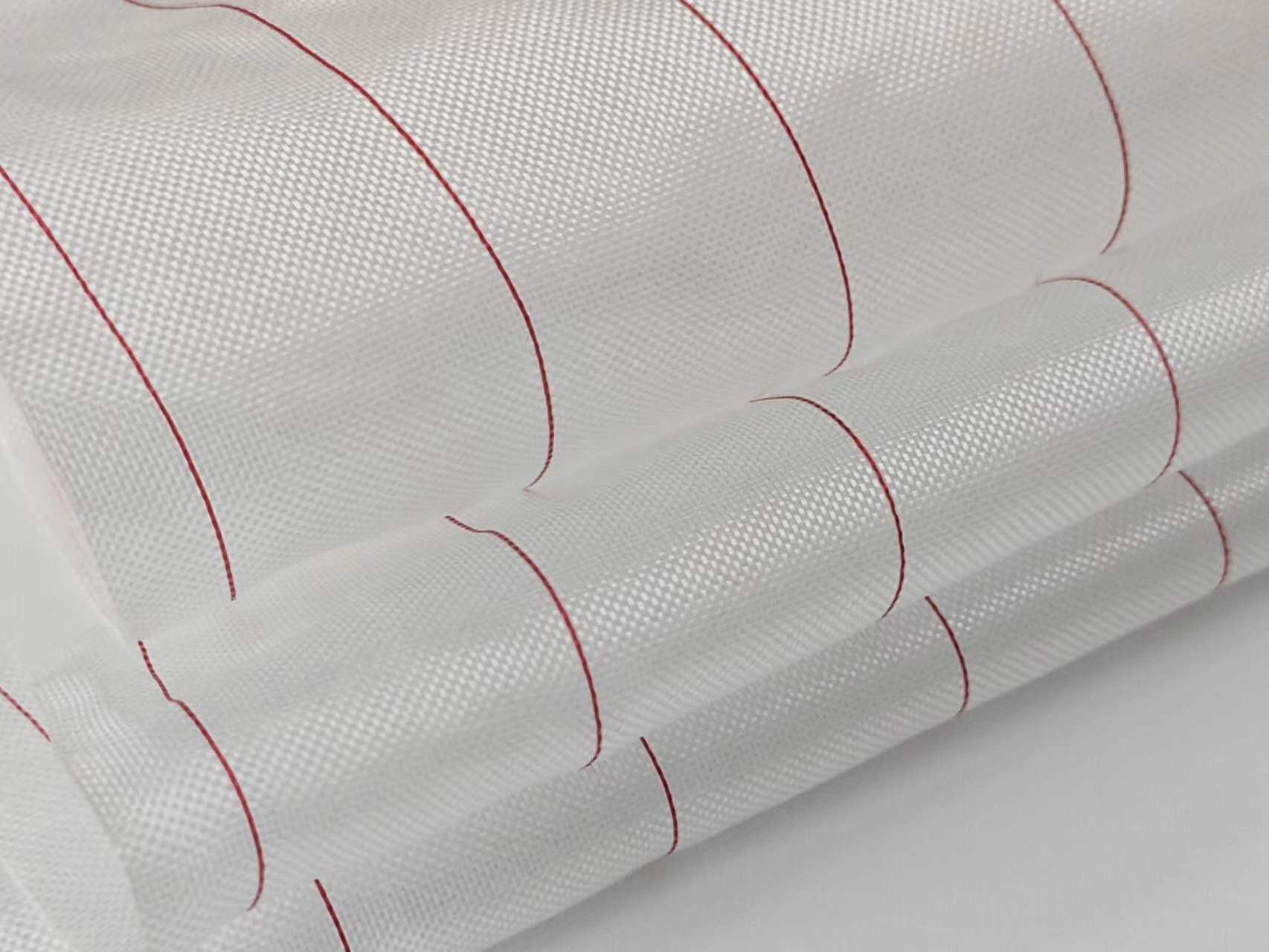
Peel ply is a specially woven fabric (usually polyester, nylon, or fiberglass) that you apply to the surface of a wet composite laminate before curing. Once the resin hardens, you peel the fabric away. What’s left behind is a uniform, resin-rich, textured surface that’s ideal for secondary bonding, painting, or adding more layers — without heavy abrasion.
How Peel Ply Actually Works
During wet layup, vacuum bagging, or resin infusion, you place the peel ply directly against the final reinforcement layer and wet it out with resin. The fabric acts as a sacrificial layer. As the part cures, resin flows into the tight weave. Because the ply is treated with release properties (either inherent or coated), it doesn’t stick permanently.
When you pull it off after full cure, two things happen:
- The weave pattern creates a consistent mechanical texture (tiny peaks and valleys) that provides excellent adhesive grip.
- Excess resin and any surface contaminants (such as amine blush) come off with the ply, exposing a fresh, active surface.
The result is a matte, slightly rough finish that’s far more reliable for bonding than a smooth, resin-rich tool-side surface or inconsistently sanded laminate.

Why Manufacturers Use Peel Ply
The benefits go well beyond convenience:
- Major time and labor savings — Dramatically reduces or eliminates heavy sanding and grit blasting.
- Consistent results — Every part gets the same textured surface, unlike variable hand abrasion.
- Better bond performance — Creates a clean, mechanically keyed surface that promotes strong adhesive bonds.
- Surface protection — Shields the laminate from dust, handling damage, and contamination during cure.
- Cleaner process — Helps remove tacky or contaminated surface layers in one step.
Industry experience and testing show that peel ply, when properly selected and applied, produces reliable surfaces for secondary bonding across a wide range of composite systems.
Types of Peel Ply
Not all peel plies are the same:
- Dry peel ply — The most common type. Woven polyester or nylon fabric, often scoured and heat-set for cleanliness. Some versions have a release coating. Works with most polyester, vinyl ester, and epoxy systems.
- Wet / impregnated peel ply — Pre-impregnated with resin. These can deliver more consistent performance in demanding aerospace or structural applications, but cost more.
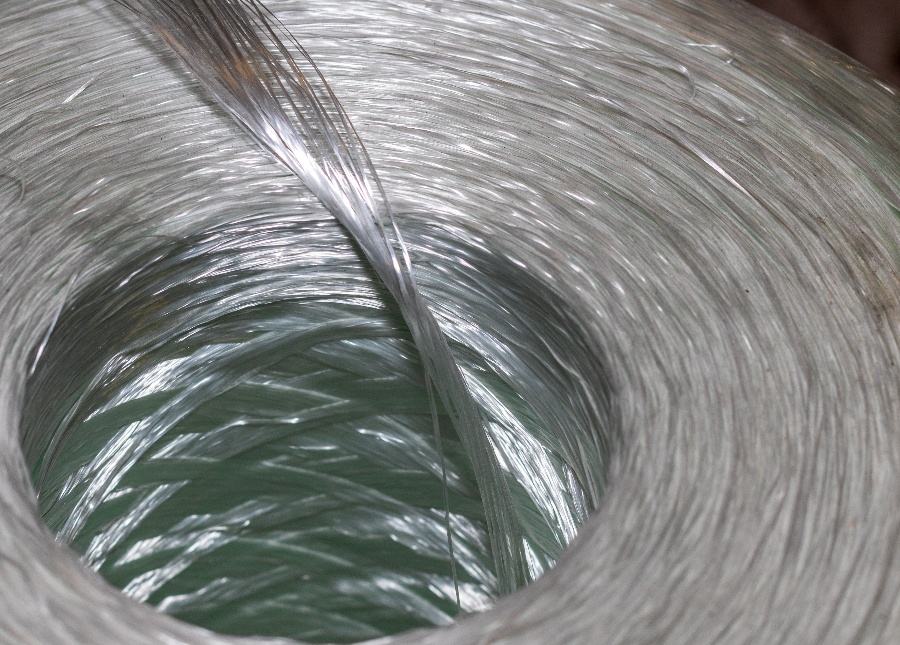
- Material choices — Polyester is versatile and cost-effective for many fiberglass jobs. Nylon handles higher cure temperatures. Glass-fiber versions are available for specific compatibility needs.
Choose based on your resin system, cure temperature, and whether the bond is structural or cosmetic.
Peel Ply and Pultrusion: The Connection
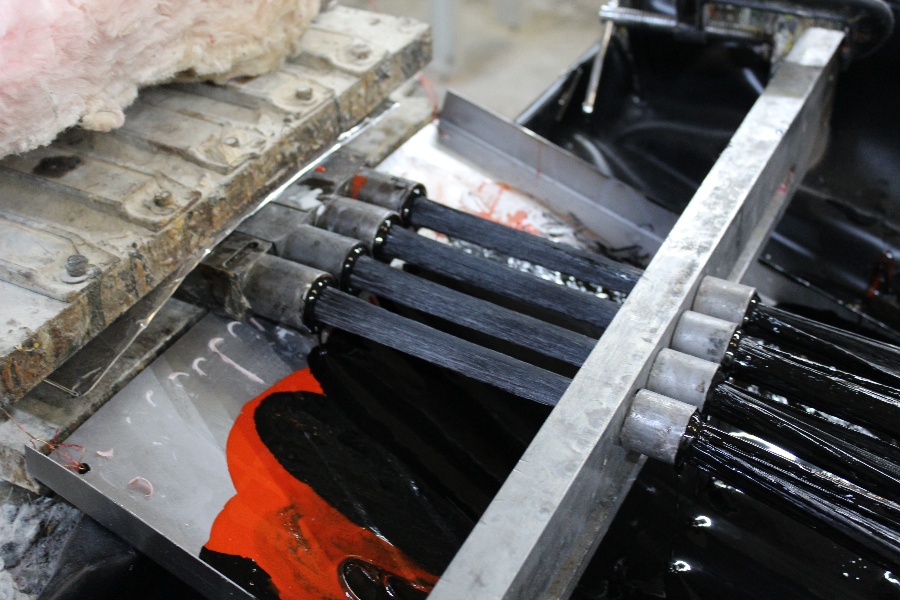
Tencom specializes in custom fiberglass pultrusion — pulling continuous reinforcements through a resin bath and a heated die to create strong, consistent profiles like tubes, rods, angles, and structural shapes. Pultrusion is a closed-die, continuous process, so peel ply isn’t applied the same way as in hand layup.
However, many pultruded FRP plates and profiles are manufactured or specified with peel ply on one or both surfaces precisely so fabricators and OEMs can prepare them quickly for adhesive bonding into larger assemblies. Remove the ply right before bonding, and you get a clean, textured interface ready for structural adhesives.
This is especially valuable in construction, infrastructure, marine, utility, and industrial applications where pultruded components are joined to other parts or structures.
The industry continues to evolve. Recent innovations in carbon pultrusion have even demonstrated techniques that improve bond strength while eliminating traditional peel ply entirely — showing that surface preparation remains an active area of development.
Best Practices for Using Peel Ply
For best results:
- Cut the ply slightly oversized or in easy-to-manage strips/pieces.
- Apply it to a fully wetted laminate and smooth it down to remove air.
- Make sure the peel ply itself is thoroughly wet out — no dry spots.
- Allow complete cure before removal.
- Peel at a low angle or use a plastic tool/razor to start an edge if needed.
- Inspect the surface after peeling — it should be uniform, dry to the touch, and textured.
Remember: the textured surface is ideal for bonding but usually requires fairing or a primer to achieve a high-gloss cosmetic finish.
Key Takeaways
- Peel ply is a woven release fabric that creates a consistent, textured, bond-ready surface on cured composites.
- It saves significant labor compared to traditional sanding while improving repeatability.
- It works across wet layup, vacuum bagging, and infusion processes — and is commonly used on pultruded profiles intended for secondary bonding.
- Proper material selection and application technique matter. Critical structural bonds sometimes combine peel ply with light abrasion for maximum reliability.
- The composite industry continues to innovate in surface preparation, including new pultrusion methods that may reduce reliance on traditional peel ply.
Whether you’re building custom pultruded profiles or integrating them into larger bonded structures, understanding peel ply helps you design smarter downstream processes and get better long-term performance from your composite parts.
At Tencom, we bring nearly 30 years of pultrusion expertise to every project — from material selection and profile design to understanding how your parts will be assembled and finished. If you’re working on applications that involve bonding or secondary operations, our team can help you specify the right profiles and surface considerations from the start.
Need help with a custom fiberglass pultruded solution? Reach out — we’re ready to engineer it with you.