

Choosing a fiberglass rod for a load-bearing structure, outdoor installation, or electrical assembly means balancing competing engineering variables. Get one wrong, and you face premature cracking, UV degradation, or insulation failure that costs far more than the rod itself. Tencom manufactures custom pultruded fiberglass rods engineered to match your exact mechanical and environmental requirements.

This guide walks you through the most important specification criteria: mechanical loading, outdoor durability, electrical insulation, resin selection, quality verification, and sourcing strategy. By the end, you will have a systematic framework for specifying fiberglass rods that perform reliably in your application.
Key Takeaways: Specifying Fiberglass Rods for Industrial Applications
- Mechanical specification starts with load case analysis that matches tensile, flexural, and shear requirements to the rod's fiber architecture and resin matrix.
- Outdoor durability depends on UV stabilization, surface veil protection, and resin system selection calibrated to your specific exposure conditions.
- Electrical insulation performance hinges on resin matrix composition, fiber volume fraction, and moisture absorption rates under your operating environment.
- Tencom engineers custom pultruded fiberglass rods with resin systems, reinforcement packages, and secondary operations matched to your project's conditions.
- Quality consistency across production lots requires verified fiber volume fraction, void content below 2%, and Barcol hardness checks on every batch.
Why Fiberglass Rod Specification Requires More Than a Catalog Lookup
Standard catalog rods are designed for general-purpose use. They assume average loads, mild environments, and no electrical requirements. Your project rarely fits that mold.
When you specify a rod for a conductor assembly, a structural support in a chemical plant, or an outdoor guy wire anchor, you need a specific combination of flexural strength, dimensional tolerance, and environmental resistance. The catalog options get close… but not close enough.
The gap between "close enough" and "specified correctly" shows up in the field: premature cracking from UV exposure, unexpected deflection under sustained load, or insulation breakdown when moisture infiltrates the resin matrix. Each of those failures traces back to a specification that did not account for the full picture.
How Do You Specify Fiberglass Rods for Load-Bearing Applications?
Load-bearing specification starts with defining your rod's operating conditions: static versus dynamic loading, expected service temperature range, and safety factor requirements. These variables determine the minimum material properties your rod must achieve.
Tensile strength and flexural strength are the primary mechanical properties for structural fiberglass rods. For pultruded rods, tensile performance depends on fiber volume fraction and fiber alignment along the rod axis. A well-made pultruded rod with 55% to 65% glass fiber content can deliver tensile strength well above what most structural applications demand.
Flexural strength matters when your rod carries bending loads or spans between supports. The fiber architecture, specifically the ratio of unidirectional rovings to mat reinforcement, controls how the rod resists bending. More unidirectional fiber increases axial stiffness; adding mat layers improves transverse and shear performance at the cost of some axial properties.
What Safety Factors Should You Apply?
Standard practice for static structural applications calls for a safety factor of 3:1 to 4:1 against guaranteed tensile strength. Guaranteed strength, as defined under ASTM D7957 for reinforcement applications, equals the mean tensile strength minus three times the standard deviation. This statistical definition rewards consistent manufacturing because lower variability produces higher guaranteed values.
For dynamic or fatigue applications, you need additional derating. Under cyclic loading, fiberglass rods accumulate micro-damage over time, and the fatigue limit depends on the resin system, fiber-matrix interface quality, and the ratio of peak stress to ultimate strength. If your application involves repeated loading, specifying a rod without fatigue data for that specific resin and fiber combination is a risk.
How Does Fiber Architecture Affect Load Performance?
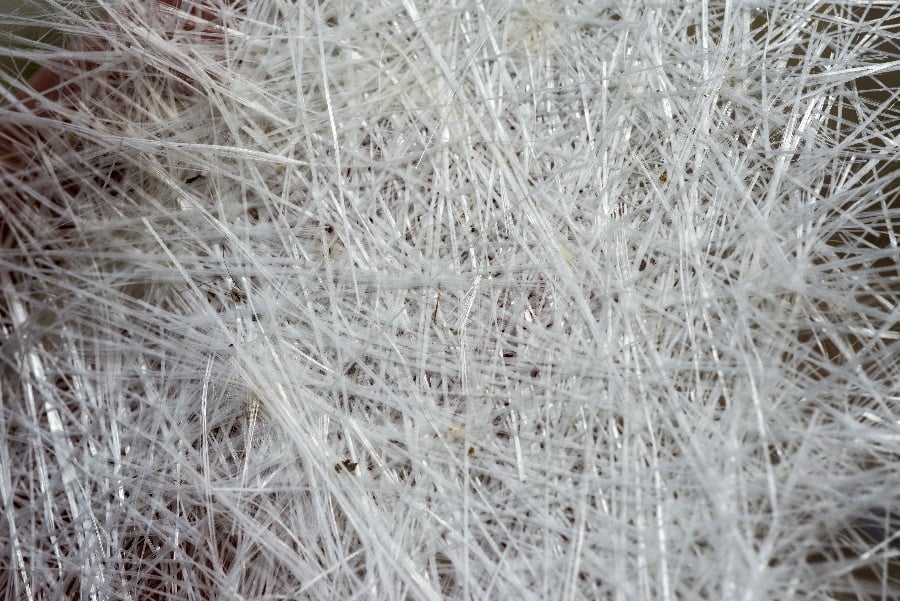
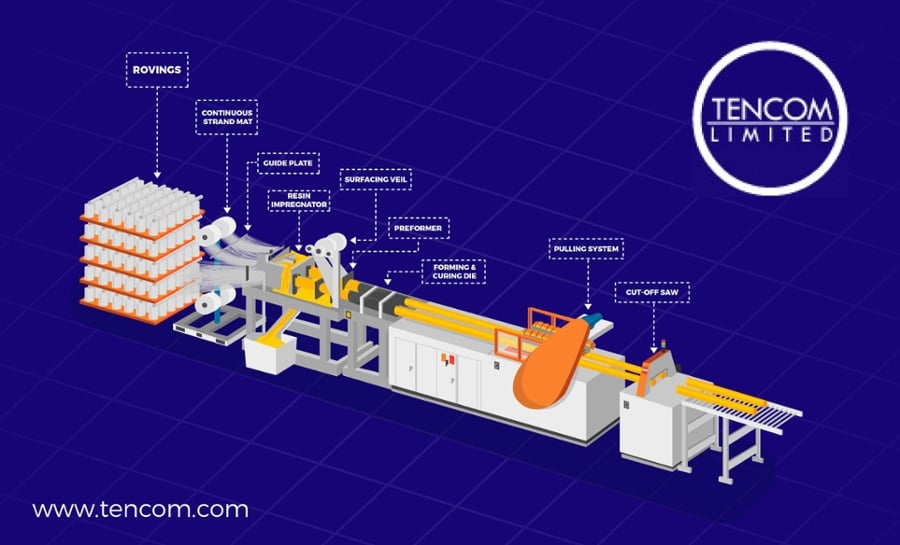
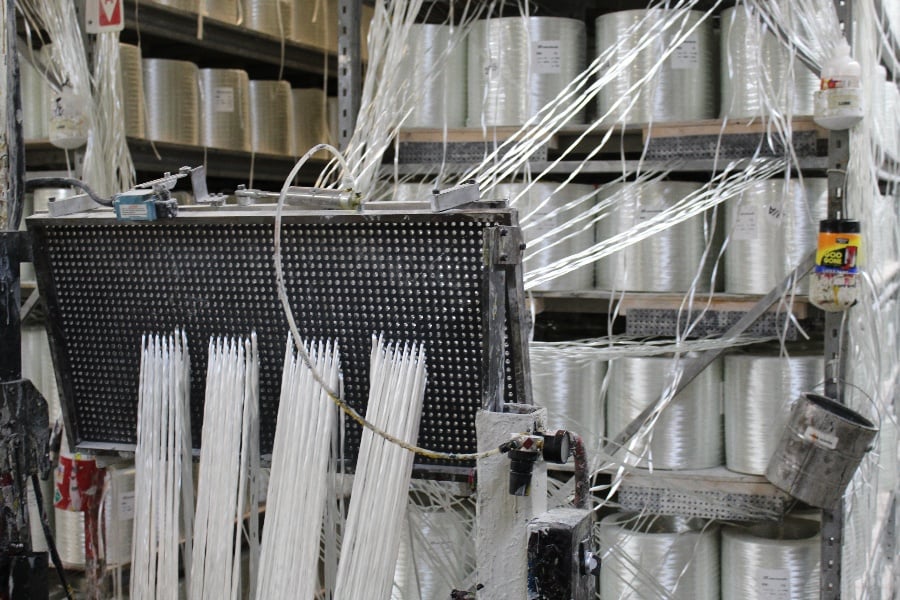
Fiber architecture is the rod's internal reinforcement layout. In pultruded rods, the primary reinforcement consists of continuous unidirectional glass rovings pulled through a resin bath and cured in a heated die. This process produces rods with high axial strength and stiffness because the fibers align directly with the pulling direction.
Adding continuous strand mat or woven fabric layers between the roving bundles changes the rod's off-axis properties. A rod intended to resist lateral forces or torsional loads benefits from this hybrid reinforcement package, while a purely tension-loaded rod performs optimally with maximum unidirectional fiber content.
Tencom's engineers review your load cases, safety factors, and installation constraints during design. This collaborative approach builds the reinforcement package around your specific application rather than adapting a generic catalog option.
What Resin Systems Work for Outdoor Fiberglass Rod Applications?
Outdoor exposure subjects fiberglass rods to UV radiation, moisture cycling, temperature extremes, and in some regions, chemical fallout or salt spray. The resin matrix is the first line of defense against all of these.
Vinyl ester resins offer the broadest protection for outdoor industrial applications. They resist moisture absorption better than standard polyester and tolerate a wider range of chemical exposures. For marine or coastal applications where salt spray and humidity are constant factors, vinyl ester is typically the baseline specification.
Isophthalic polyester resins perform well in atmospheric outdoor applications where chemical immersion is not a concern. They cost less than vinyl ester and provide adequate UV and moisture resistance when combined with proper surface protection. For general structural outdoor use in mild to moderate climates, isophthalic polyester often provides the right balance of performance and total cost of ownership.
How Does UV Radiation Degrade Fiberglass Rods?
UV photons break polymer chains in the resin matrix, causing surface chalking, microcracking, and eventual fiber exposure. A 2025 study published in Polymer Composites confirmed that prolonged solar radiation triggers both chain scission and crosslinking in the polymer structure, leading to brittleness and loss of mechanical strength in unprotected composites.
Two protective measures address UV degradation in pultruded fiberglass rods. First, UV stabilizers and inhibitors compounded directly into the resin formulation absorb radiation before it damages the polymer backbone. Second, a synthetic surface veil applied during pultrusion acts as a physical barrier, scattering UV energy before it reaches the structural resin beneath.
Specifying both protections together delivers significantly longer outdoor service life than either alone. When you work with Tencom, we select the resin formulation and surface veil based on your specific exposure conditions, not a one-size-fits-all default.
What Role Does Moisture Play in Outdoor Rod Degradation?
Moisture infiltration is slower than UV damage but equally destructive over time. Water migrates through microcracks in the resin surface and along fiber-matrix interfaces, weakening the bond that transfers load from resin to fiber. In freeze-thaw climates, trapped moisture expands and contracts cyclically, accelerating crack growth.
For outdoor rods, specify a resin system with low water absorption (1% or less in 24-hour immersion per ASTM D570) and ensure adequate surface veil coverage to reduce moisture-related degradation. Rods intended for buried or submerged service face more aggressive moisture exposure and typically require vinyl ester or epoxy resin systems with verified long-term hydrolytic stability.
How Do You Specify Fiberglass Rods for Electrical Insulation?
Fiberglass rods serve as electrical insulators in conductor assemblies, utility infrastructure, and industrial equipment where non-conductivity is a safety requirement. The insulation performance of a pultruded fiberglass rod depends on the resin system, fiber content, moisture level, and surface condition.
Dielectric strength measures the rod's ability to resist electrical breakdown under voltage stress. For standard E-glass and vinyl ester pultruded rods, dielectric strength values are sufficient for most distribution-voltage insulation applications. Higher voltage requirements or demanding environmental conditions may call for specialized resin formulations or additional surface treatments.
Why Does Moisture Affect Electrical Performance?
Water is a conductor. Even small amounts of moisture absorbed into the resin matrix or trapped at fiber interfaces reduce the rod's insulation resistance and dielectric strength. For electrical applications, specifying a rod with verified low moisture absorption under your operating conditions is not optional.
Rods used in conductor assemblies for utility infrastructure face particular challenges: they operate outdoors, endure thermal cycling that pumps moisture in and out of microcracks, and must maintain insulation integrity over decades. The resin matrix must resist moisture transport to the fiber interface where most electrical failures initiate.
What Causes Cracking in Conductor Rod Assemblies?
A 2025 review in Energies documented multiple failure modes in composite insulator core rods, including brittle fracture, decay-like fracture, and electrical failures from moisture ingress. The common thread across these failure modes is stress concentration at the fiber-matrix interface, often initiated by manufacturing voids or environmental exposure.
Specifying a rod with void content below 2% (verified per ASTM D792), adequate resin-to-fiber bonding, and UV-stabilized surface protection reduces the risk of these failure modes. Tencom's in-house quality verification includes Barcol hardness testing, fiber volume fraction checks, and dimensional inspection on every production lot to ensure consistency across your order.
What Quality Control Criteria Should You Require from Your Rod Supplier?
Quality in pultruded fiberglass rods is determined during manufacturing, not recovered through post-production inspection. Specifying the right material is only half the job; verifying that the manufacturer delivers consistent quality lot after lot is equally important.
The following quality criteria address the most common sources of performance variation in pultruded rods:
- Fiber volume fraction (55% to 65% for structural rods): Verified by burn-off per ASTM D2584. Low fiber content reduces strength; high fiber content leaves insufficient resin to protect fibers from the environment.
- Void content below 2% by volume: Measured by density comparison per ASTM D792. Voids above 2% disproportionately reduce shear and compressive properties.
- Barcol hardness within specification range: Tested per ASTM D2583 on every production lot. Low readings indicate under-cured resin, which compromises both mechanical and environmental performance.
- Dimensional tolerance per ASTM D4385: Consistent cross-section geometry ensures your rod fits the first time, reducing installation rework and field modifications.
How Do You Evaluate Manufacturing Consistency?
Ask your supplier for statistical process control data on pulling force and die temperature during production runs. Stable pulling force indicates consistent die lubrication, resin cure state, and rod dimensions throughout the run. Die temperature logs confirm that cure conditions remained within specification across every zone.
Tencom maintains in-house engineering and testing capabilities that enable custom research and quality verification for your specific application. With nearly 30 years of focused pultrusion experience, our engineers can often suggest small design changes that deliver outsized performance gains while maintaining quality consistency across production lots.
How Does Total Cost of Ownership Factor into Rod Specification?
The purchase price of a fiberglass rod is a fraction of its total cost of ownership. Maintenance, replacement frequency, installation labor, and downtime costs accumulate over the rod's service life and often dwarf the initial material expense.
When those hidden costs add up, the "cheaper" standard option stops looking like a bargain. A rod specified with the right resin system, reinforcement package, and surface protection for your environment delivers lower total cost of ownership through longer service life, fewer replacements, and reduced maintenance interventions.
For SMB industrial buyers and purchasing managers, this calculation matters more than unit price. A custom pultruded rod from Tencom that fits your application precisely avoids the downstream costs of adaptation, early failure, and repeated procurement cycles that accumulate when you settle for a generic option.
What Are Common Fiberglass Rod Failure Modes and How Do You Prevent Them?
Understanding failure modes helps you write specifications that prevent them. The most common fiberglass rod failures in industrial applications fall into three categories.
UV-Driven Surface Degradation
Unprotected rods exposed to sustained sunlight develop surface chalking within months, followed by fiber blooming and loss of mechanical properties. Prevention requires UV-stabilized resin formulation combined with a synthetic surface veil. For high-UV environments, specifying both protections is essential.
Moisture-Induced Fiber-Matrix Debonding
Water migrating along the fiber-matrix interface weakens load transfer and initiates delamination under sustained stress. Low-absorption resin systems (vinyl ester or epoxy) combined with complete wet-out during manufacturing minimize this risk. Void content below 2% is critical because voids provide pathways for moisture infiltration.
Fatigue Cracking Under Cyclic Loading
Rods subjected to repeated loading develop micro-damage that accumulates until macro-cracking occurs. The fatigue threshold depends on resin toughness, fiber-matrix adhesion, and the peak-to-ultimate stress ratio. Specifying a rod with verified fatigue data for your loading profile, rather than relying on static strength alone, prevents unexpected field failures.
How Do You Source Fiberglass Rods for Smaller Production Runs?
Many pultruders focus on high-volume orders because their tooling costs and production minimums favor long runs. This leaves SMB buyers and project teams with limited options: accept a standard catalog shape that does not quite fit, or pay a premium for a custom run that exceeds your actual volume requirement.
Tencom's custom pultrusion process accommodates lower minimums than most competitors, making custom-engineered rods accessible for smaller buyers. The engineering review process addresses your exact resin matrix, fiber architecture, profile geometry, and secondary operations (cutting, drilling, machining, notching) as a single-source package.
That single-source approach reduces lead times, minimizes handling damage between vendors, and gives you one accountable partner for the entire scope. For project teams managing tight timelines and limited budgets, this consolidation removes coordination risk and simplifies your supply chain.
What Standards and Test Methods Apply to Fiberglass Rod Specification?
Specification documents reference standards at two levels: material specification standards that define acceptance criteria, and test method standards that define how properties are measured. Knowing which standards apply to your application prevents specification errors.
- ASTM D7957: Primary U.S. material specification for glass fiber reinforced polymer bars for concrete reinforcement. Covers mechanical properties, dimensional tolerances, and durability testing.
- ASTM D3916: Tensile testing of pultruded glass fiber reinforced polymer rods for structural (non-rebar) applications.
- ASTM D790: Flexural property testing by three-point or four-point bending. The failure mode observed provides diagnostic information about composite quality.
- ASTM D2344: Short-beam shear test measuring interlaminar shear strength. Sensitive to void content, incomplete cure, and fiber-matrix adhesion quality.
- ASTM D2583: Barcol hardness test for rapid, non-destructive cure verification on production rods.
For structural applications, ensure your specification references the correct material standard and test methods for your market. ASTM and CSA standards can produce different guaranteed strength values for identical material because of different test-conditioning protocols.
A Step-by-Step Framework for Specifying Fiberglass Rods
Use this framework as a checklist when developing your rod specification. Each step addresses a variable that affects field performance.
- Define your load case: Document static and dynamic loads, safety factors, and service temperature range. This determines minimum tensile, flexural, and shear requirements.
- Map your exposure environment: Identify UV intensity, moisture conditions, chemical exposures, and temperature cycling. This drives resin system selection and surface protection requirements.
- Specify electrical requirements: If the rod must insulate, define voltage class, required dielectric strength, and acceptable moisture absorption limits.
- Select the resin system: Match the resin to your combined mechanical, environmental, and electrical requirements. Vinyl ester covers most demanding industrial applications; isophthalic polyester serves milder conditions.
- Define the reinforcement package: Choose fiber type, volume fraction, and architecture (unidirectional, hybrid, or mat-reinforced) based on your load case analysis.
- Establish quality acceptance criteria: Specify fiber volume fraction range, maximum void content, Barcol hardness range, and dimensional tolerances.
- Verify supplier capability: Confirm that your supplier maintains statistical process control, lot traceability, and the in-house testing equipment needed to verify your specification.
This structured approach eliminates guesswork and ensures every specification decision connects to a measurable performance requirement.
In Conclusion: How to Specify Fiberglass Rods That Perform in Your Application
Specifying fiberglass rods correctly means working backward from your application's actual conditions, not forward from a catalog. Load cases, environmental exposure, electrical requirements, and quality consistency all factor into a specification that prevents premature failure and reduces total cost of ownership.
Tencom starts with your requirements and works backward to the right solution. Our engineers review your mechanical loads, environmental exposure, electrical needs, and installation constraints to develop a custom pultruded rod that fits the first time and performs year after year with minimal maintenance. Reach out to our team to find out whether a custom pultruded fiberglass rod makes sense for your application.

FAQs About Specifying Fiberglass Rods
What is the minimum fiber volume fraction for structural fiberglass rods?
Structural pultruded fiberglass rods typically require 55% to 65% fiber volume fraction, verified by burn-off testing per ASTM D2584. This range balances mechanical strength with adequate resin coverage to protect fibers from environmental attack.
Which resin system provides the longest outdoor service life for fiberglass rods?
Vinyl ester resin combined with UV stabilizers and a synthetic surface veil delivers the longest outdoor durability for most industrial fiberglass rod applications. Tencom formulates custom resin systems matched to your specific UV, moisture, and chemical exposure conditions.
How do you verify that a fiberglass rod meets electrical insulation requirements?
Dielectric strength testing and moisture absorption testing under your operating conditions verify electrical performance. Tencom's in-house testing capabilities confirm insulation properties on production rods, ensuring your conductor assemblies maintain integrity over their full service life.
What void content is acceptable in pultruded fiberglass rods?
Void content should remain below 2% by volume, measured per ASTM D792. Higher void levels disproportionately reduce shear and compressive strength, and voids provide pathways for moisture infiltration that accelerates degradation in outdoor and electrical applications.
Can you order custom fiberglass rods in smaller quantities?
Tencom accommodates lower production minimums than most pultruders, making custom-engineered fiberglass rods accessible for SMB buyers. The engineering review covers resin selection, fiber architecture, profile geometry, and secondary operations as a single-source package.
What ASTM standards should a fiberglass rod specification reference?
Key standards include ASTM D7957 for concrete reinforcement rods, ASTM D3916 for structural rod tensile testing, ASTM D790 for flexural properties, ASTM D2344 for interlaminar shear, and ASTM D2583 for Barcol hardness. Your specification should reference the standards that match your application type.