Beam stiffness determines how much a structural member resists bending and deflection under load. In construction, manufacturing, and product design, it’s often more critical than raw strength—because a beam that sags too much fails in practice even if it doesn’t break.

What Exactly Is Beam Stiffness?
Beam stiffness (also called flexural rigidity) measures a beam’s ability to resist deformation when subjected to bending moments. It’s commonly denoted as EI, where:
- E is the modulus of elasticity (Young’s modulus) of the material — how stiff the material itself is.
- I is the moment of inertia of the beam’s cross-section — a geometric property that shows how the material is distributed relative to the neutral axis.
The product EI acts like a spring constant for bending. Higher EI means less deflection (curvature) for the same applied moment.
From beam theory (Euler-Bernoulli), the relationship is:
M = EI × κ (or 1/ρ), where M is the bending moment, κ is curvature, and ρ is the radius of curvature.
This explains why deeper beams, or those with material farther from the center (such as I-beams or hollow sections), feel much stiffer.
Why Beam Stiffness Matters More Than You Might Think
Strength tells you when a beam will fail or yield. Stiffness controls everyday performance:
- Limits deflection to prevent bouncy floors, cracked ceilings, or sticking doors.
- Maintains alignment in machinery or structural systems.
- Reduces vibrations and improves long-term durability.
- Influences load distribution in indeterminate structures (stiffer members attract more moment).
A strong but overly flexible beam might pass load tests but disappoint in real-world service. In composites like fiberglass pultrusions, engineers often optimize layups and section shapes specifically for high EI while keeping weight low.
Key Factors That Affect Beam Stiffness
Several variables control how stiff a beam actually is:
- Material Properties (E) — Steel has a high E (~200 GPa), while fiberglass composites and wood are lower but can compete through geometry. Pultruded FRP often uses high fiber volume fractions in the longitudinal direction for excellent bending stiffness.
- Cross-Section Geometry (I) — Moment of inertia dominates. Doubling depth can increase I dramatically (scales with depth cubed for many shapes). I-beams, tubes, and box sections position material away from the neutral axis to maximize efficiency.
- Length (Span) — Deflection often scales with L³ or L⁴. Longer spans demand much higher stiffness.
- Support Conditions and Loading — Fixed ends, continuous spans, or distributed vs. point loads change effective stiffness behavior.
- Shear Deformation — Important for short, deep beams or composites with lower shear modulus (Timoshenko beam theory accounts for this).
Pro tip: In design, increasing depth is often far more effective than adding width or material thickness for boosting stiffness.
Calculating Beam Deflection (Putting Stiffness to Work)
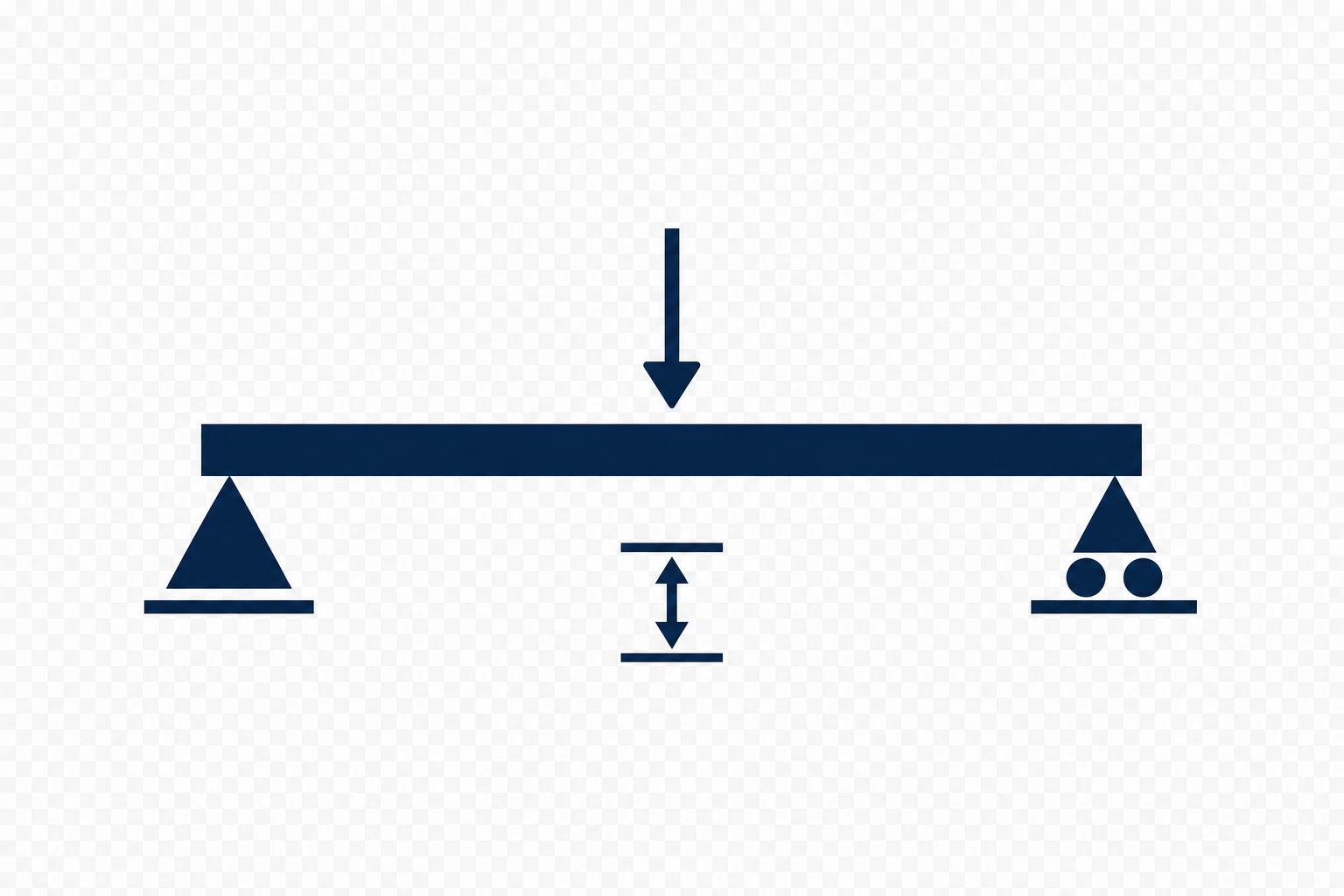
Common formulas (for simply supported beams) illustrate EI’s role:
- Central point load: δ_max = PL³ / (48 EI)
- Uniform distributed load: δ_max = 5wL⁴ / (384 EI)
These show why EI appears in the denominator — higher stiffness directly reduces deflection.
Engineers use these in hand calcs, finite element analysis, or stiffness matrix methods for complex frames.
Beam Stiffness in Composites and Pultrusion
Fiberglass pultruded beams shine here. By aligning continuous fibers longitudinally, manufacturers achieve high longitudinal E while tailoring I through custom profiles (rods, tubes, channels, grating). This delivers excellent stiffness-to-weight ratios for applications like:
- Utility infrastructure
- Marine and corrosion-resistant structures
- OEM components
- Bridge decks and platforms
Unlike isotropic metals, composites allow directional stiffness optimization — perfect for beams that primarily bend in one plane.
Key Takeaways for Better Beam Design
- Beam stiffness is governed by EI — combine strong materials with smart geometry.
- Prioritize depth and shape (I-beams, boxes) over just adding mass.
- Always check serviceability (deflection limits) alongside strength.
- In composites, fiber orientation and layup are your levers for efficiently tuning stiffness.
- Use appropriate theory: Euler-Bernoulli for slender beams; Timoshenko when shear matters.
Mastering beam stiffness leads to lighter, stronger, and more reliable designs across industries. Whether you’re specifying pultruded profiles or traditional steel beams, the principles remain the same: control deflection, and you control performance.