
Window frames face a hidden threat that appears quickly once a building is occupied: distortion. Temperature swings cause frame materials to expand and contract at different rates than the glass they hold. Over years of thermal cycling, this mismatch accumulates as warped frames, failed seals, and operational headaches.

Fiberglass window reinforcement addresses that problem at the material level. Tencom manufactures pultruded fiberglass profiles that match the thermal expansion rate of glass, limiting the stress that causes frames to bend or bow over time.
This article explains how fiberglass reinforcement keeps window frames dimensionally stable and why that stability matters for the structural integrity of windows over decades of service.
Key Takeaways: How Fiberglass Window Reinforcement Reduces Warp
- Fiberglass expands at nearly the same rate as glass, reducing stress on seals and joints during temperature changes.
- Pultruded fiberglass profiles resist warping, bowing, and sagging far longer than other reinforcement materials.
- Tencom engineers custom fiberglass window reinforcement profiles to meet specific stiffness and dimensional requirements.
- Low thermal conductivity in fiberglass reinforcement eliminates thermal bridging that can compromise energy efficiency.
- Long-term dimensional stability extends window service life and reduces callbacks from window frame distortion.
Why Do Window Frames Warp Over Time?
Window frames exist in a demanding environment. They absorb heat from direct sunlight, then cool rapidly after sunset. In hot climates, frame surface temperatures can reach 160°F or higher on summer afternoons before dropping by 50 degrees overnight.
Each material responds differently to these swings. When the frame material expands or contracts at a different rate than the glass, stress accumulates at connection points. This repeated cycle leads to window frame distortion: warped profiles, gaps in weather seals, and sashes that no longer operate smoothly.
The problem compounds with larger windows. As spans increase, even small dimensional changes become visible and operational issues become unavoidable.
How Does Thermal Expansion Cause Frame Distortion?
Every material has a coefficient of thermal expansion (CTE)—a measure of how much it changes dimension per degree of temperature change. Float glass has a CTE of approximately 5.0 × 10⁻⁶ per °F.
The closer a frame material matches that number, the less relative movement occurs between the frame and glass. When the CTE mismatch is large, temperature changes create shear forces at the seal line that eventually cause failure.
According to research from the National Fenestration Rating Council, fiberglass frames have a CTE almost identical to that of glass. This means the frame and glazing expand and contract together, keeping seals intact and corners square over decades of service.
What Makes Fiberglass Different from Other Reinforcement Materials?
Traditional window reinforcement relies on steel or extruded sections that bring significant CTE mismatch to the assembly. The result: stress concentration that leads to long-term warping.
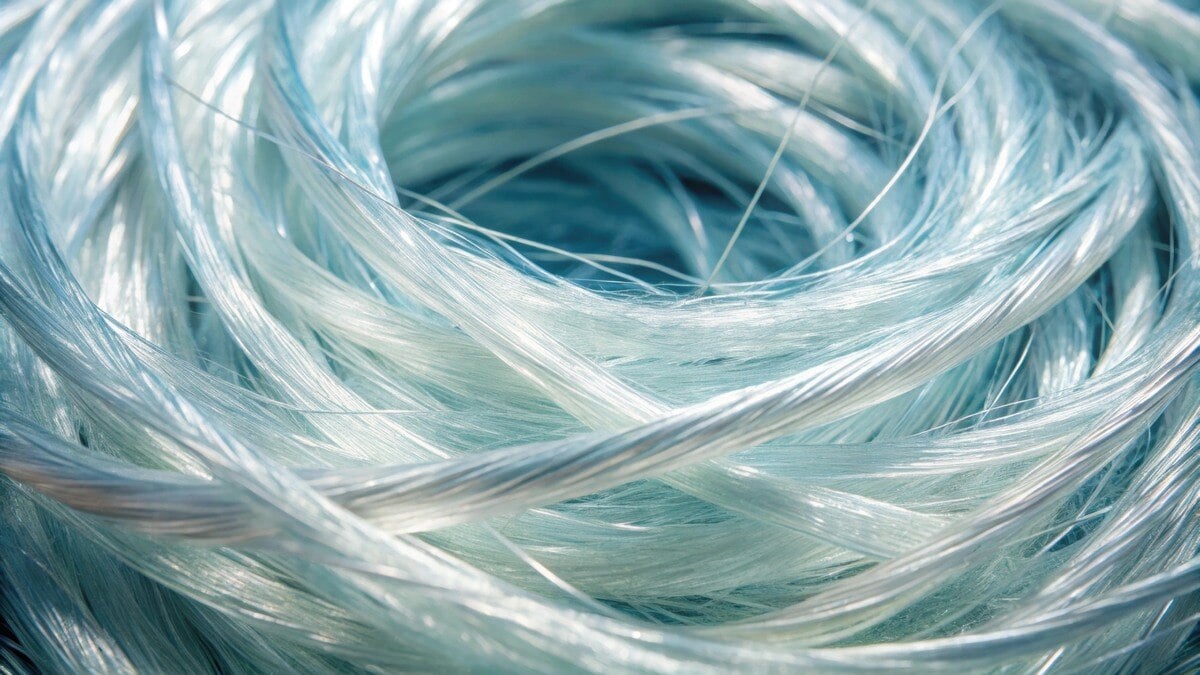
Pultruded fiberglass offers a fundamentally different approach. The material consists of continuous glass fibers saturated in a thermoset resin matrix, pulled through a heated die to create precise cross-sections. This process delivers:
- A CTE nearly identical to window glass
- High stiffness-to-weight ratio for structural support
- Zero thermal bridging due to low thermal conductivity
- Resistance to warping, even at elevated temperatures
Tencom's pultruded fiberglass reinforcement profiles give window manufacturers the stiffness they need without the thermal penalties of traditional materials.
How Does Fiberglass Reinforcement Improve Window Structural Integrity?
Structural integrity in a window depends on the frame maintaining its shape under load—both mechanical loads like wind pressure and thermal loads from temperature cycling.
Fiberglass reinforcement contributes to window structural integrity in three ways. First, the high tensile and flexural strength of pultruded fiberglass allows frames to resist deflection under wind loads without requiring heavy cross-sections.
Second, dimensional stability means the frame geometry stays consistent over time. Corners remain square. Weather seals maintain contact. Hardware alignment stays true.
Third, pultruded fiberglass does not creep under sustained load the way some thermoplastic materials do. A fiberglass-reinforced frame installed today will hold its shape for decades.
What Are the Thermal Performance Benefits of Fiberglass Reinforcement?
Energy efficiency matters as much as mechanical performance in modern fenestration. Traditional reinforcement materials often create thermal bridges that allow heat to bypass the insulating glass unit entirely.
Fiberglass breaks that thermal path. With thermal conductivity approximately 500 times lower than that of conductive materials, pultruded fiberglass reinforcement acts as an insulator rather than a conductor.
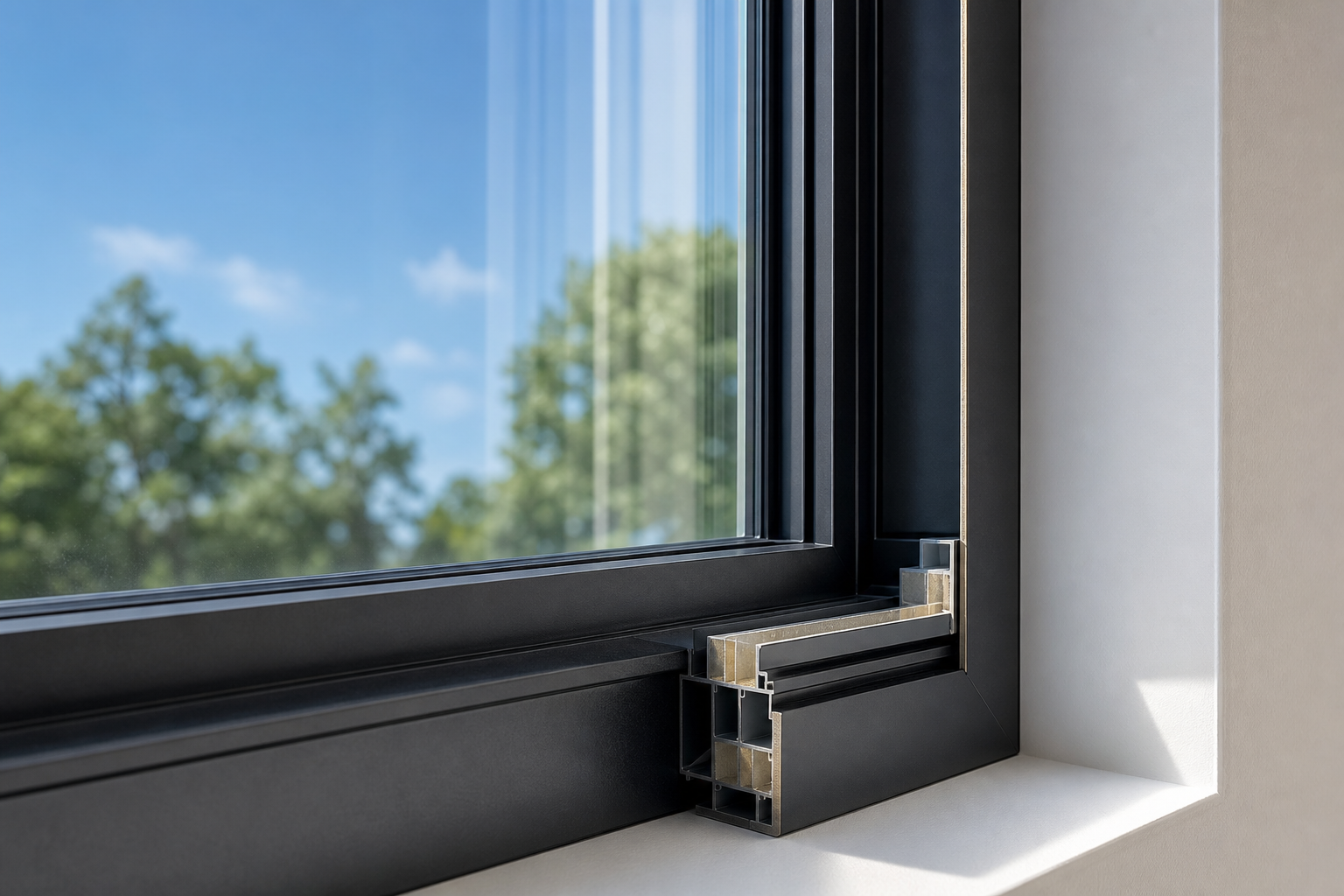
Tencom's thermal fiberglass window reinforcements are engineered to integrate into existing vinyl window systems while delivering both structural support and energy performance. This combination helps window manufacturers meet increasingly stringent energy codes without redesigning their entire frame system.
How Are Pultruded Fiberglass Window Profiles Manufactured?
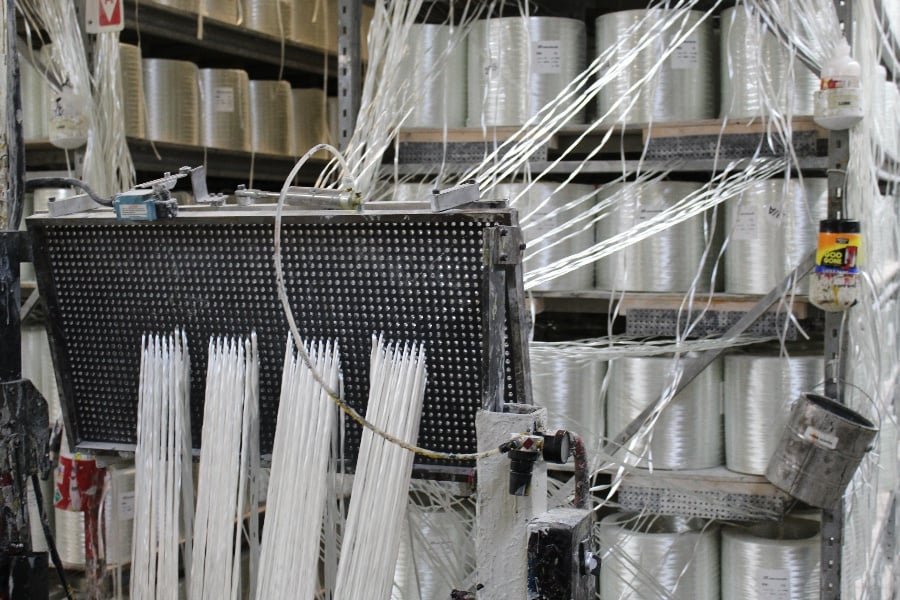
The pultrusion process creates fiberglass profiles with consistent cross-sections and predictable mechanical properties. Continuous glass fiber rovings pass through a resin bath, then enter a heated die where the material cures into a rigid, dimensionally accurate shape.
This process yields profiles with tight tolerances—Tencom holds ±0.005" across the fabrication process—and uniform fiber distribution throughout the cross-section. The result is a reinforcement that performs predictably from part to part and batch to batch.
Custom profile geometries allow the reinforcement to drop directly into existing window frame cavities. Tencom works with fenestration customers to design profiles that maintain or improve the stiffness and strength of original parts while eliminating thermal bridging.
Where Is Fiberglass Window Reinforcement Used?
Window manufacturers incorporate fiberglass reinforcement into a range of product lines:
- Residential vinyl windows seeking ENERGY STAR certification
- Commercial storefront and curtain wall systems
- Large-format picture windows and sliding glass walls
- High-rise applications where wind loads demand additional stiffness
- Coastal and extreme-climate installations exposed to severe temperature cycling
In each case, the goal is the same: deliver a frame that performs on day one and continues to perform year after year without the dimensional drift that leads to callbacks and warranty claims.
What Should Window Manufacturers Consider When Specifying Reinforcement?
Selecting the right reinforcement profile involves balancing several factors. Frame cavity dimensions determine what geometries are feasible. Required stiffness and strength depend on window size, configuration, and expected wind loads.
Temperature range matters too. Fiberglass reinforcement can withstand operating temperatures from -50°F to 300°F, covering essentially any climate condition a window will face.
Tencom's engineering team collaborates with customers early in the design process to match reinforcement profiles to specific performance requirements. That partnership continues through tooling, production, and any secondary operations, such as cutting to length or adding machined features.
FAQs about How Fiberglass Window Reinforcement Reduces Warp
Why does fiberglass reduce frame warping better than other materials?
Fiberglass has a thermal expansion coefficient nearly identical to glass. When temperatures change, the frame and glazing expand together rather than creating stress at the seal line. Tencom's pultruded profiles maintain this stability over decades of temperature cycling.
Can fiberglass reinforcement fit into existing window frame designs?
Yes. Tencom engineers custom profiles to match specific cavity dimensions and stiffness requirements. This allows window manufacturers to upgrade reinforcement materials without redesigning their entire frame system.
How long do fiberglass-reinforced window frames last?
Pultruded fiberglass does not degrade, warp, or creep under normal service conditions. Fiberglass-reinforced frames routinely deliver 50+ years of service with maintained dimensional stability. Tencom's profiles are engineered for this kind of long-term performance.
Does fiberglass reinforcement help with energy efficiency?
Absolutely. Fiberglass has very low thermal conductivity, so it does not create thermal bridges the way conductive materials do. Tencom's thermal fiberglass window reinforcements help window systems meet strict energy codes while maintaining structural performance.
What tolerances can Tencom hold on fiberglass window reinforcement profiles?
Tencom maintains tolerances of ±0.005" throughout the fabrication process. This precision ensures consistent fit and performance across production runs, which matters for high-volume window manufacturing.