

Interest in thermoplastic pultrusion keeps rising. Engineers hear about recyclability, toughness, and the ability to remelt a profile after it leaves the line.Those features are real in controlled processes. They are also easy to overstate when the only process you know is conventional thermoset pultrusion.
Before you write “thermoplastic pultrusion” into a specification, it helps to understand how the process actually works, where the claimed advantages still have limits, and when a proven thermoset system remains the lower-risk path to a custom profile.
How Thermoplastic Pultrusion Differs from Thermoset
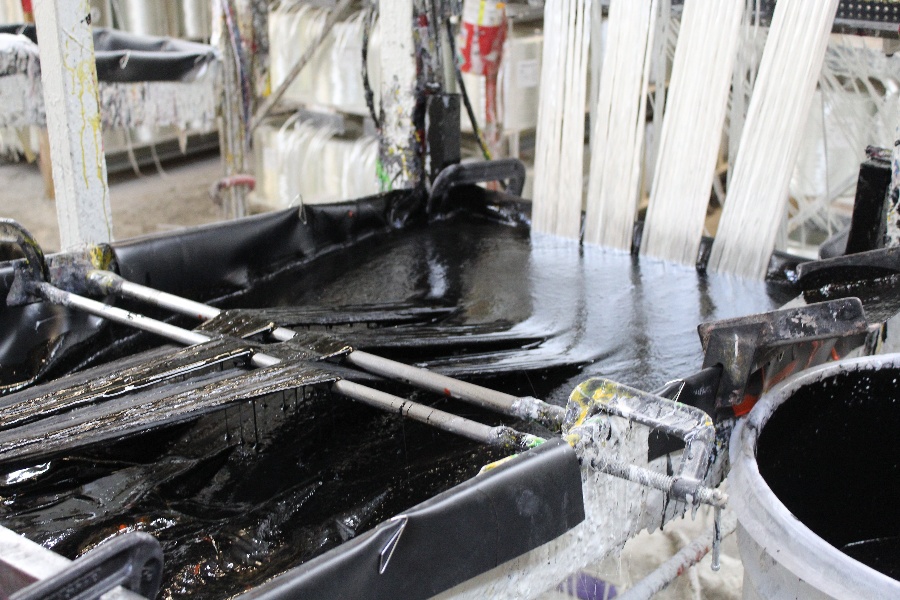
Standard thermoset pultrusion — the process used for most commercial custom profiles — pulls continuous fiber through a liquid resin bath (polyester, vinyl ester, epoxy, phenolic, or polyurethane). The wet fiber enters a heated die, the resin cures chemically, and the solid profile is pulled out and cut to length. Once cured, the matrix is crosslinked. It does not melt again.
Thermoplastic routes work differently. Fiber is combined with a thermoplastic polymer (or with reactive components that form one). The profile is shaped and then solidifies by cooling rather than by irreversible crosslinking. That is why thermoplastic profiles can, in principle, be remelted.
Practical routes include:
- Direct melt — coat the continuous fiber with molten thermoplastic, then shape and cool.
- Use of preconsolidated tapes or commingled yarns that are heated, consolidated, and cooled.
- Reactive chemistry — low-viscosity components impregnate the fiber more easily, then react to form a thermoplastic matrix. The process still involves melting (or combining), forming, and cooling; the advantage is better fiber wet-out before the matrix becomes a high-viscosity thermoplastic.
High melt viscosity remains the central challenge for non-reactive routes. Thermoset resins wet fiber easily. Thermoplastic melts are far more viscous, so full impregnation, low porosity, and consistent fiber volume require more heat, pressure, and process control. That is one reason thermoplastic pultrusion is still a smaller commercial category than thermoset.
Where the Advantages Are Real — and Where They Need Context
When the process is under control, thermoplastic profiles offer several genuine differences:
- Toughness and impact resistance — Many thermoplastic matrices absorb energy better than brittle thermosets, except in very cold conditions. When thermoplastics get cold enough, they become more brittle than typical thermosets. You will not see many thermoplastics carrying significant load in Alaska. At more moderate temperatures, they tend to dent, deflect, and move rather than shatter, which can reduce damage to the reinforcing fibers.
- Weldability and reformability — Profiles can be joined by welding or locally remelted for secondary forming in some systems. Important limit: continuous fibers remain separate. Unless the weld zone reaches full melt and re-consolidation, the joint is still a surface bond of the original thermoplastic. It is not automatically stronger or more reliable than a properly designed adhesive bond on a thermoset profile. Specialized adhesives for thermosets remain a mature, well-understood joining method.
- Recyclability potential — The matrix can be remelted, which opens end-of-life options that crosslinked thermosets do not have.
- Low VOC processing — No solvent-based wet-out and no styrene emissions from a typical polyester bath.
- Shelf-stable intermediates — Prepreg tapes and commingled yarns do not have the same pot-life constraints as wet thermoset resins.
These features matter when a program specifically needs circularity, weldable assemblies, or high-impact performance in temperate conditions. They matter less when the primary requirements are corrosion resistance, dielectric strength, dimensional stability, and a custom cross-section produced at consistent quality and cost.
Practical Limits Engineers Run Into
Commercial experience and process data show the same constraints:
- Higher processing temperatures and more demanding tooling
- Difficulty achieving the high fiber volume fractions and low porosity that thermoset lines routinely deliver (especially on non-reactive routes)
- Greater shrinkage and dimensional-control challenges as the melt cools
- Narrower commercial availability of custom shapes, resins, and secondary operations compared with mature thermoset pultrusion
- Higher material and process cost for most custom industrial volumes
Mechanical properties can be competitive in well-made axial profiles. They are not automatically superior. A carefully designed glass/polyester, vinyl ester, or polyurethane thermoset profile still sets the benchmark for many structural, utility, and fenestration applications.
When Thermoplastic Makes Sense — and When It Doesn’t
Consider thermoplastic pultrusion when the program specifically needs:
- Demonstrable end-of-life reprocessing
- High impact toughness as a primary driver in temperate service
- Compatibility with downstream thermoplastic overmolding or assembly (thermoset profiles are also successfully overmolded with thermoplastics)
- Welding, with the clear understanding that fiber continuity across the joint is limited unless full re-consolidation occurs
Stick with established thermoset pultrusion when the priorities are:
- Proven corrosion, UV, and chemical performance
- Tight dimensional control and secondary machining
- Custom complex cross-sections at prototype-to-production volumes
- Cost and lead time that purchasing can live with
- Established documentation and adhesive bonding practices
- Reliable performance in extreme heat and cold
Tencom’s custom fiberglass pultrusion services cover the thermoset side of that decision: polyester, vinyl ester, epoxy, phenolic, and polyurethane systems, with profiles up to 15" wide and 6" high and tolerances to .005" on many features. Specialty resin packages are detailed on the specialty resin systems page. Typical mechanical properties appear under material properties.
Polyurethane is sometimes discussed alongside thermoplastics because of its toughness. In conventional pultrusion, it is still a thermoset that cures in the die. It delivers higher toughness and often higher line speeds than standard polyester without requiring a full thermoplastic process change.
What to Ask Before You Specify “Thermoplastic Pultrusion”
If the requirement is real, put these questions in the RFQ:
- Which thermoplastic matrix and which impregnation route (direct melt, tape, commingled, or reactive)?
- What fiber volume, porosity, and axial vs. transverse properties are guaranteed?
- Can the supplier produce the exact cross-section, length, and secondary features at the volume needed?
- How is dimensional stability controlled through cooling?
- For welded joints, is full melt and re-consolidation achieved, or is the joint a surface bond? How does it compare with adhesive bonding of an equivalent thermoset profile?
- What is the documented recyclability process, and has it been demonstrated on this profile?
- What is the lowest service temperature, and how does the matrix behave at that temperature?
- How do lead time and cost compare with an equivalent thermoset profile?
Vague language such as “must be recyclable thermoplastic composite” rarely survives design review or purchasing. Specific process, property, and joining requirements do.
Key Takeaways
- Thermoplastic pultrusion solidifies by cooling (or reactive chemistry that forms a thermoplastic), not by irreversible thermoset cure.
- Reactive routes improve impregnation by starting with lower viscosity before the matrix becomes a thermoplastic.
- Toughness advantages are real except in extreme cold, where thermoplastics can become more brittle than typical thermosets.
- Welding does not automatically restore continuous-fiber continuity. Without full melt and re-consolidation, it remains a surface bond of the original thermoplastic.
- You can also overmold thermoset profiles with thermoplastics.
- For most custom industrial, utility, and fenestration profiles, established thermoset systems still deliver the best combination of performance, cost, and availability.
- Specify matrix, process route, properties, temperature range, and joining method explicitly if thermoplastic is required.
If a drawing calls for thermoplastic performance but the actual needs are strength, corrosion resistance, and a custom cross-section, start with a thermoset options review. Tencom can compare resin systems, fiber architecture, and secondary operations against the service environment before committing to tooling.

FAQ Section
What is thermoplastic pultrusion?
It is a continuous process that combines continuous fiber with a thermoplastic matrix (or reactive components that form one) and solidifies the profile by cooling. Unlike thermoset pultrusion, the matrix is not permanently crosslinked.
How does thermoplastic pultrusion differ from standard thermoset pultrusion?
Thermoset resins are liquid, wet the fiber easily, and cure chemically in a heated die. Thermoplastics are higher-viscosity melts. Reactive routes start with lower viscosity for better impregnation before the matrix becomes thermoplastic.
Is welding thermoplastic composites better than bonding thermosets?
Not automatically. Continuous fibers remain separate. Unless the weld achieves full melt and re-consolidation, it is still a surface bond of the original thermoplastic. Specialized adhesive bonding of thermoset profiles remains a mature and reliable joining method.
How do thermoplastics perform in extreme cold?
Many are tougher than brittle thermosets at moderate temperatures, but when they get cold enough, they become more brittle than typical thermosets. Significant load-bearing thermoplastic applications are rare in extreme cold climates.
When should an engineer specify thermoplastic instead of thermoset pultrusion?
When recyclability, high impact toughness in temperate service, or specific thermoplastic assembly is a primary requirement, and the joining method and low-temperature behavior have been validated. For most custom structural, utility, and fenestration profiles, established thermoset systems still offer better cost, availability, and proven performance across temperature ranges.