
Boosting Pallet Strength and Logistics Efficiency with Custom Fiberglass Stiffener Rods from Tencom Ltd.
How Tencom Ltd. helped a prominent pallet manufacturer replace heavy, corrosion-prone metal reinforcements with custom-engineered pultruded fiberglass rods — delivering meaningful weight reduction, improved durability, and lower long-term costs while meeting required load and deflection performance.
Reduction in Overall Pallet Weight
Reduction in Material Cost per Reinforcement
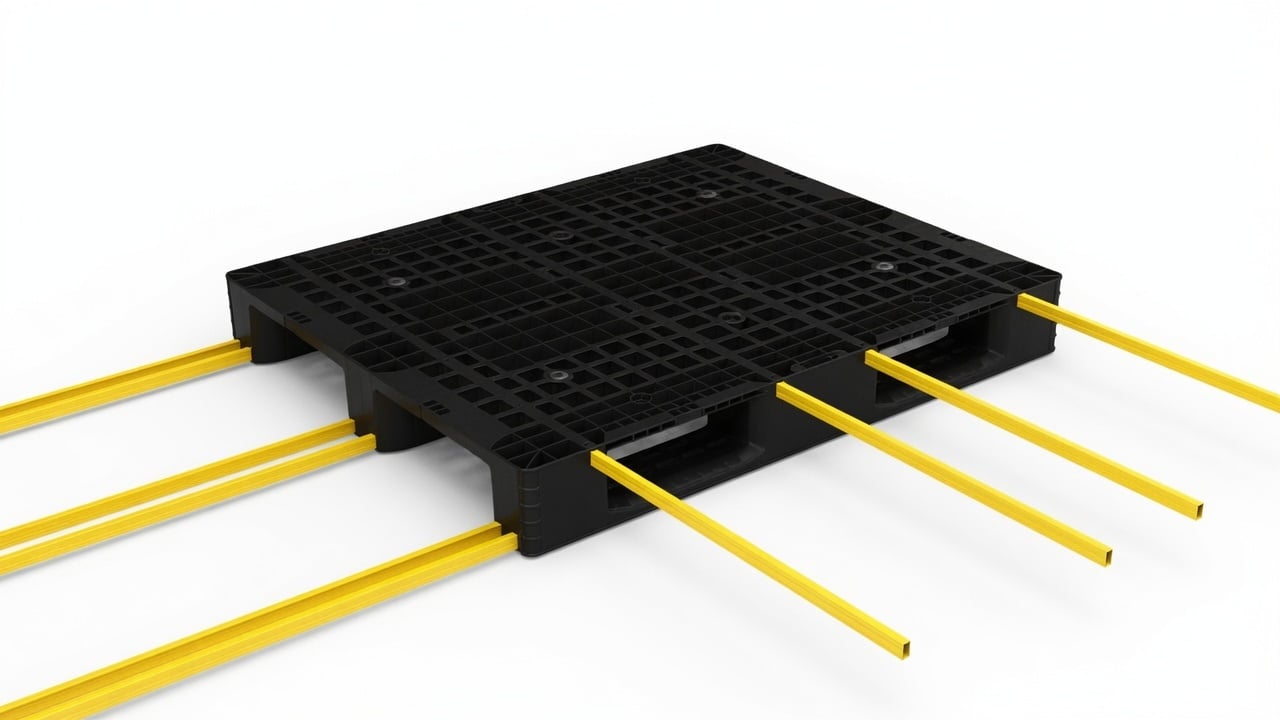
Executive Summary
A mid-sized industrial pallet manufacturer needed lighter, more durable reinforcements for high-volume logistics and warehousing applications. Traditional steel stiffener rods provided stiffness but added excess weight, were susceptible to corrosion, and drove higher shipping and maintenance costs. In 2024, the company partnered with Tencom Ltd. to develop custom pultruded fiberglass (FRP) stiffener rods tailored to their pallet designs and performance requirements.
The solution focused on achieving the necessary structural performance (strength and controlled deflection) at lower weight, rather than a direct one-for-one diameter swap with steel.
Client Background
The client produces wooden, plastic, and composite pallets for retail, manufacturing, and e-commerce supply chains. Their designs must handle repeated heavy loading, forklift impacts, and harsh warehouse conditions while meeting standards such as ISO 8611 and IPPC requirements for international shipping.
Previously, they relied on steel stiffener rods. These rods delivered the needed rigidity but introduced three persistent problems: added weight that raised shipping costs and handling difficulty, corrosion in humid or chemically exposed environments, and rising material costs.
Enhancing Durability While Reducing Weight and Costs in High-Volume Logistics
Weight and Mobility
Corrosion and Maintenance
Load Performance and Compliance
Economic Pressures
FRP offered clear advantages in density and corrosion resistance, but its lower modulus of elasticity (typically 1/5 to 1/5.5 that of steel) meant a same-diameter rod would be less stiff. A successful solution required proper sizing and fiber architecture so that the finished pallet still met deflection and strength targets while capturing weight and durability benefits.
Custom Pultruded Fiberglass Stiffener Rods
Tencom worked with the client’s engineering team to design a custom pultruded FRP rod optimized for the specific pallet geometry and performance envelope.
Design approach: Rather than matching the original steel diameter exactly, Tencom used finite-element analysis and physical prototyping to select the diameter, fiber volume, and resin system so the rods delivered the required bending stiffness and ultimate capacity under the client’s load cases. Because FRP density is roughly one-quarter that of steel, even a moderately larger cross-section still produced a substantial net weight reduction.
Key material characteristics of the final rods
- Density approximately 1.9 g/cm³ (roughly 75% lower than steel by volume)
- High glass-fiber content in a vinyl-ester matrix for good chemical resistance and mechanical properties
- Tensile and flexural strengths well-suited to the application; compressive performance sized to meet the required factors of safety
- Complete immunity to rust and excellent resistance to common industrial chemicals and moisture
- Textured surface and optional pre-drilled features for reliable integration into the pallet structure
The final rod diameter and lay-up were chosen so that pallet-level deflection under design loads remained within acceptable limits while the overall assembly became significantly lighter.
Manufacturing Process
Tencom’s process included joint design reviews, die development, prototyping, and production scaling. Prototypes were tested for fit, adhesion, and structural performance. Third-party verification confirmed that the reinforced pallets met or exceeded the relevant ISO load and durability requirements.
Full production integration required only minor process adjustments and was completed within the planned timeline.
The handles are integrated directly into the client's assembly lines, requiring minimal process changes.
Manufacturing Process
The project commenced in Q2 2024 with a trial batch of 1,000 pallets. The client embedded the fiberglass rods during pallet construction, using adhesives or mechanical fasteners. Third-party testing at labs like SGS verified:
- Load Capacity: Exceeded ISO requirements with 20% higher yield strength.
- Durability: No degradation after 500-hour accelerated weathering tests.
- Impact Resistance: Withstood repeated drops from 4 feet without cracking.
Full production scaled to 200,000 units/month by Q4 2024. Initial challenges, such as optimizing adhesion in humid conditions, were swiftly resolved through Tencom's technical consultations. "Their hands-on guidance turned setup hurdles into streamlined efficiencies," said the client's Production Lead.
Tangible Enhancements in Performance and Cost-Effectiveness
After six months of field use, the client reported the following outcomes relative to the previous steel-reinforced design:
| Metric | Before (Steel) | After (Fiberglass) | Change |
|---|---|---|---|
| Typical Pallet Weight | ~50 lbs. | ~35-37 lbs. | ~25-30% lighter |
| Load Capacity (tested) | Baseline | Met/exceeded targets | Maintaineds or Improved |
| Material Cost/Rod | Higher | Lower | ~20%+ Reduction |
| Corrosion-related Maintenance | Ongoing | Essentially Eliminated | Major Savings |
| Service Life in wet/chemical environments | Limited by Rust | Extended | Noticeable Increase |
Business Impact
First-year savings from lower material costs, reduced freight, and lower maintenance more than offset the transition. The lighter pallets also improved ergonomics for workers and supported the client’s sustainability goals by reducing weight and the need to frequently replace corroded metal parts.
Financial Impact
Operational Gains
Sustainability
A Framework for Advancing Pallet Innovation
By treating the reinforcement as an engineered system rather than a simple material swap, Tencom and the client produced FRP stiffener rods that delivered the required structural performance at lower weight and with far better corrosion resistance than steel. The result is a more efficient, lower-maintenance pallet that better meets the demands of modern logistics.
This approach—sizing FRP components to the application's actual stiffness and strength needs rather than forcing an equal-diameter comparison—is the practical way to capture the benefits of composites in pallet and material-handling designs.